

Are Intentional Communities the Way Forward?

Placeholder image for Foundation for Intentional Community website.
Foundation for Intentional Community
  • June 25, 2025
  • Economics & Law
  • Governance
  • Health & Well-Being
  • Social Justice
  • Sustainability
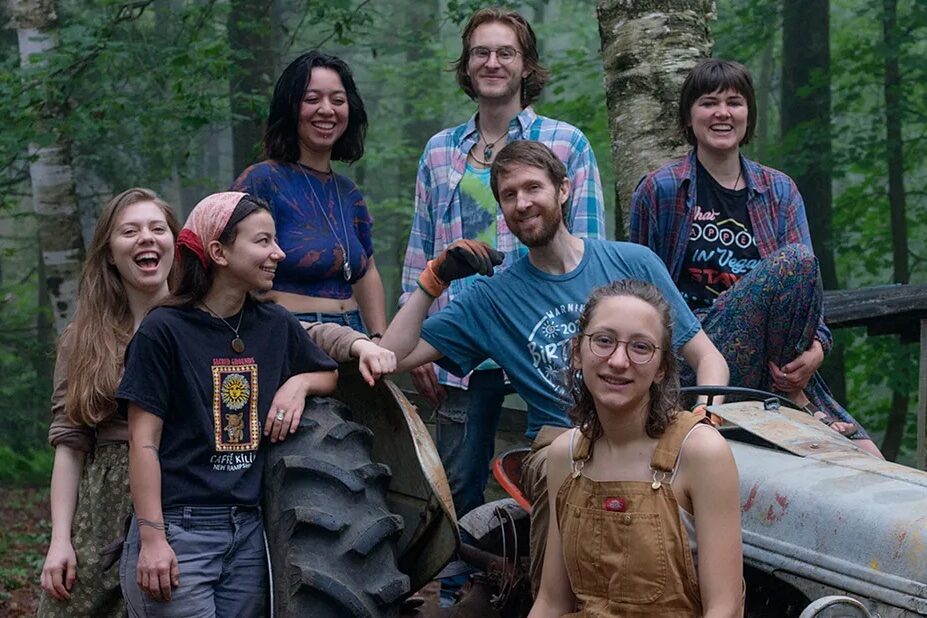
Group of diverse young adults smiling outdoors with tractor in a forest setting.

This is an introductory excerpt from the article published by Teen Vogue. Photo by Holly Lynton. Article written by Brittney McNamara.

On one of the first nice days of spring in New England, Madison Healey, Jo Fuchs, and Gabriel Futterman sit around a wooden table in Kailasha house, the space they share with four others, picking at a bountiful lunch and deep in conversation about what it means to live in a place like this.

Sun washes through a large bank of windows in the rear of the house, blanketing the numerous plants and multicolored textiles in the open-concept living and dining rooms with its warmth. The space is bright, big, and quite lovely, qualities you might not guess from the unassuming exterior — aging wood coats the outside of the home, and there’s no decoration to speak of. At the table, Healey, whose deep green tank top and floral skirt mirror the tulip stems emerging from the freshly thawed ground outside, talks about the importance of conflict resolution, while Futterman talks about his larger utopian vision. They are residents of the Sirius Community in Shutesbury, Massachusetts, an intentional community and ecovillage centered around sustainable living.
Sirius is one of thousands of intentional communities across the country and the world, where people who often share values congregate to live in a more sustainable, communal way. Intentional communities are incredibly diverse, and there are many ways of building these kinds of groups — it’s likely that no two look the same. Still, they hinge on a group of people sharing both space and ideas, working toward a common goal. If mainstream society is largely individualistic, encouraging single people or families to rely on themselves for their needs, intentional community is about refilling your neighbor’s cup, and knowing they’ll do the same for you.
But Healey, 30, Fuchs, 22, and Futterman, 25, are in the minority in intentional communities at large. While young people lead the intentional community movement of the ‘60s and ‘70s, it’s less common now to see swaths of people in their late teens or early 20s opt for this kind of life. Still, young people online seem to be interested, even if it’s only expressed through internet trends. The rise of the cottagecore aesthetic and interest in trad wife content is often rooted (at least in part) in an attraction to a “simpler” life, one less dependent on technology and more connected to nature and tradition. For people in intentional communities, their lifestyle may be an alternative to a mainstream that many young people see as increasingly broken.

“The reason I’m here is not because it’s a comfortable, beautiful, lovely place to live — which it is — but because it is, for me, an act of prefiguration. That means [to] live now what you want to see in the future, build what you’re working for post-revolution into the act of revolution and into all of your actions,” he says. “When that system crumbles and falls apart, [it’s about making sure] there is an alternative for people to go to.”

“Living Laboratories”

Futterman sees intentional communities as sites of “utopian experimentation,” which Kanney affirms. Kanney refers to intentional communities as “living laboratories.”

“Intentional community is, by definition, living with a group of people on shared land or housing and doing so intentionally, so that you’re writing agreements, have a governance system, and structuring it,” she says. Still, intentional communities can take a vast array of forms.

You might be most familiar with this concept through the hippie communes of the 1960s and 70s, but that’s not the only model for these groups, nor the first. According to Community Finders, the first intentional community in recorded history was Homakoeion, a vegetarian group that formed in 525 BCE. Now, intentional communities may be nestled in the woods like Sirius, or may form in bustling city centers. Intentional communities might require residents to share their income, or have residents make their own money. Some may function largely off-grid while others very much rely on city services…

Comments

Featured Blogs

Keep the conversation going with these pieces

Foundation for Intentional Community
Tue Nov 2019
  • Living in community
  • Governance
Diana Leafe Christian shares Earthaven Ecovillage’s “graduated series of consequences” and how it works. Originally published in Communities magazine.
Foundation for Intentional Community
Tue Nov 2019
  • Living in community
  • Life Transitions
Raising children in community has different impacts than in a single family home. Alicia J. George from Takoma Village shares the most significant ways our three adopted boys’ behavior affected our cohousing community and how we worked jointly to deal with the impact.
Eva Goldfarb
Wed Aug 2025
  • Living in community
  • Governance
Intentional communities are not immune to the Fair Housing Act – and for many good reasons. However, it also impacts how we create safe spaces and small living groups. Read a brief history of the FHA, how it impacts IC’s, and how the FIC is responding to it.
Sky Blue
Tue Mar 2024
  • Living in community
  • Economics & Law
So we’ve all moved into intentional communities to have a positive influence on our world. Now what? The impact of our movement is at a crossroads and it needs more. Lifelong communitarian, Sky Blue, writes an open letter to the intentional communities movement.
Foundation for Intentional Community
Wed Jul 2026
  • Living in community
  • Health & Well-Being
A Q&A with Hank Gamel and Fran Biederman, about living in an intergenerational neighborhood called Hope Meadows. Excerpted from Living, Together: Reimagining Community in the Age of Disconnection edited by Samantha Paige Rosen.
Cynthia Tina
Fri Oct 2021
  • Living in community
  • Life Transitions
People gathering and forming community has existed through all of history. This article lists a timeline of communities beginning in 6th Century BCE.
Daniel Greenberg
Tue Sep 2024
  • Living in community
  • Governance
In 2024, the Foundation for Intentional Community launched its inaugural event, Convergence of Intentional Communities. Daniel Greenberg recalls its successes.
davebooda
Wed May 2024
  • Living in community
  • Economics & Law
How does capitalism influence our approach to community? And how does community change our relationship to capitalism? The two are not mutually exclusive.
Foundation for Intentional Community
Tue Aug 2020
  • Living in community
  • Health & Well-Being
The BIPOC Intentional Community Council’s mission is to cultivate radically safe and inclusive communities for Black, Indigenous, and people of color by providing inspiration, solidarity, and support to those seeking to find or found communities, and to those already living in community.
davebooda
Sat Nov 2025
  • Living in community
  • Governance
“The health of any community can be measured by their relationship to disagreement.” How any intentional community reaches connection has a lot to do with how they address disagreement.

Insights & Stories from the Communities Movement

Subscribe to our newsletter for fresh stories and community updates delivered to your inbox.

Join the Communiversity Community

Get unlimited access to courses, exclusive member events, and a supportive network of community builders

Unlimited Learning

Access all courses, books, and premium content

Community Network

Member-only workshops and community builders

Exclusive Events

Member-only workshops and gatherings

Information

Communities

A residential project: people live here as their primary home.

Organizations

An institution, business, network, or project that isn’t a residence (e.g. a learning center, farm, or network with no one living there full-time).

Plus Community Memberhsip

  • Find people with Profile Match
  • Access to your community listing statistics
  • Create Discussion Groups
  • 50% commission when your members purchase a Plus Membership
  • Access to our affiliate program
  • Member badge on your community profile
I am an official member of this community
Disclaimer
I affirm that my information is accurate and I am authorized to manage this listing
Foundation for Intentional Community FIC Member badge logo.

Free Plan

Free Membership
Free

Intentional Advertising

  • Subtotal

    {{ currencyFormat( pricing_summary.total_amount ) }}

Icon representing community connections and collaboration for intentional communities.

Plus Membership

  • Find communities with Profile Match
  • View detailed reviews about communities
  • Direct message and view contact information
  • Create free listings in Needs & Offers
  • Plus Member resources in CommUniversity
  • Plus Member badge on your profile