

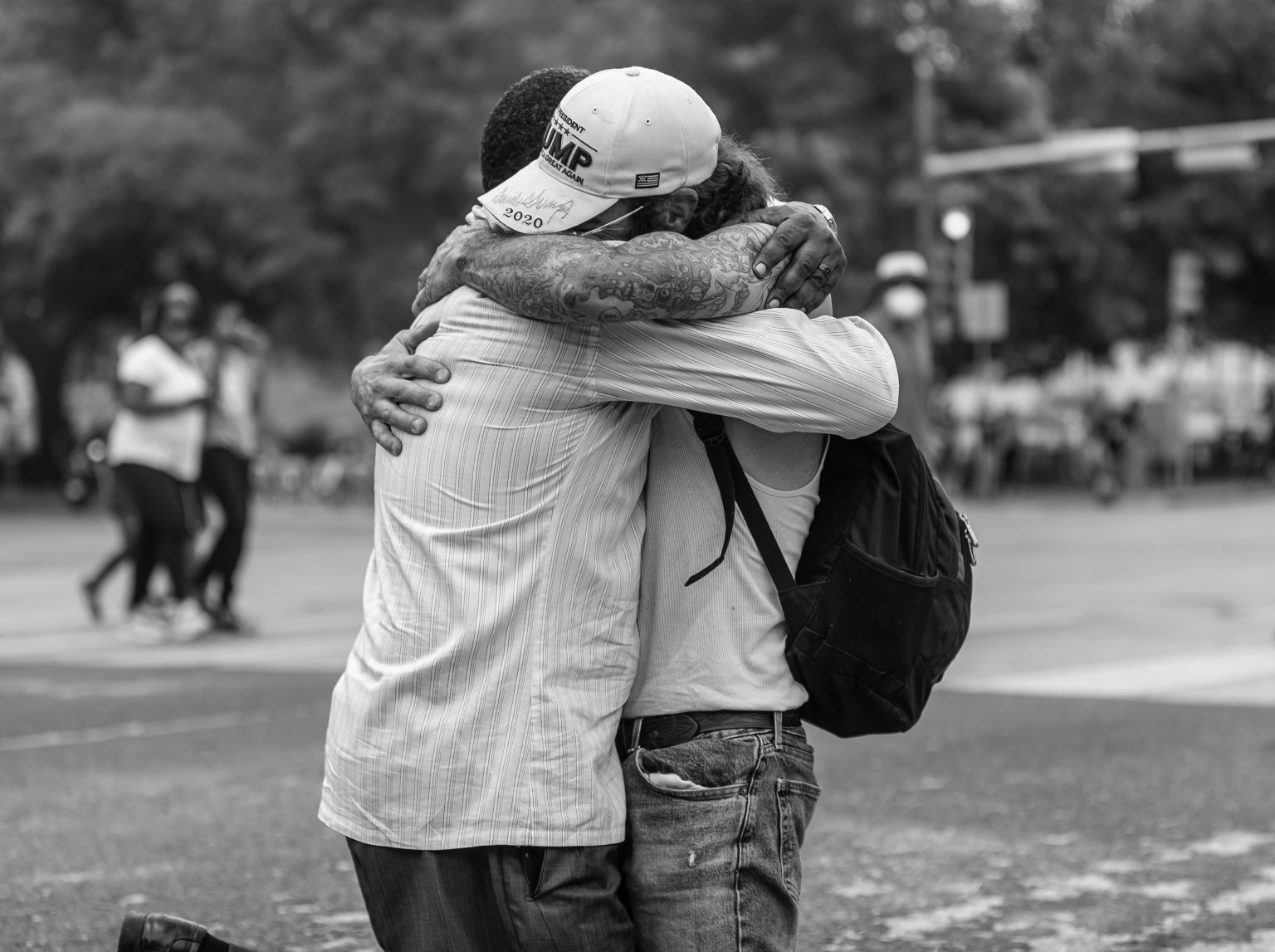
You have one perspective, I have another. We could agree to disagree. And yet, depending on how consequential the difference is, conflict may arise.
Maybe I love avocados but you find the texture repulsive. That’s manageable. Maybe you love top-40 country music and I think most of it is cookie-cutter garbage. That’s not ideal if we’re on a long road trip together, but we’ll be fine.
But what if we have different religious beliefs? What if I think that you believing in your definition of God will result in eternal damnation? What if we disagree on how to discipline our kids and we live next door to each other? What if we support different politicians, and what if you believe my support for a chosen politician constitutes bad judgment, or even harm towards our fellow citizens?
What happens when it’s okay to disagree about things like music, but it’s not okay to disagree about issues when the stakes are higher? I’d like to explore our current state of affairs, what happens when we can’t disagree and why healthy conflict is an essential ingredient to a well-functioning community.
If there’s one thing we seem to all agree on, it’s that our current culture is more polarized and divided than it has been in a long time. Our patience with and respect for people who don’t share our beliefs has waned, and as a result our ability to be with interpersonal conflict has degraded.
Thanks to innovation and technology, we have more opportunity to avoid conflict than ever before in human history. The more of our lives we spend online, the less we have to wrestle with the frustrating, yet necessary task of relating with people we don’t agree with. Our communities, once based on physical proximity are being slowly replaced by affiliations defined by moral proximity. As the internet divides us into different sub-groups based on our interests, we are left with the impression that our viewpoint isn’t just the majority, but that anyone who doesn’t see things our way must be an idiot, uninformed or both.
Being in groups of people who share our values can be useful, but if that’s all we’re exposed to our intellectual and emotional immune systems become weak. Our egos become even more fragile, and what used to be something uncomfortable, but that we could work through, is now an affront to our sensibilities, a reason for outrage or even a relational boundary we must impose. The less we are exposed to new ideas and contrary points of view, the less resilient our minds become.
Furthermore, conflict in an online reality is fundamentally different from conflict in real life. If we encounter people we don’t agree with online it’s easy to simply click away, or if we choose to engage, to do it in a way that’s essentially anonymous and detached from our humanity. It takes far less courage to leave a comment on Facebook than to say the same thing to someone’s face, or in a group of people. There’s very little skin in the game when we’re behind a keyboard. The idea of “confronting someone online” can sound courageous, but when seen from a larger perspective, it’s no more courageous than yelling at someone out your car window as you drive by.
When we don’t have the ability or the capacity to disagree with people — to sit with and accept the simple fact that we see the world differently — we are left with no choice but to make other people wrong, and it just gets worse from there.
It’s almost as if when someone disagrees with us, a “gap” gets created. Now, we could simply allow this gap to exist, or even welcome it. Our disagreement may have consequences for how we can (or can’t) dance together in life, and some of that may be a bummer, but making peace with that gap is absolutely an option.
If we can’t do that, for whatever reason, that’s when things start to get squirrelly. We rush to fill that gap with meaning, explanations or stories. Some of the ways we do this are relatively benign. We may believe “they just don’t get it”, and maybe we’re right. We may say or think things like:
They just don’t have enough experience.
They are too young to understand.
They are too old to understand.
They haven’t “seen the light” yet.
We don’t recognize their viewpoint as containing wisdom (at least not as much as ours) so we explain that away. A step toward a less civil direction would be to assign negative attributes to that person or see them as “broken”.
They are clearly wounded.
You know Jenny… she’s always been a bit racist.
Bennie is just an asshole.
If we continued in a more violent direction, we could attribute malice to their viewpoint and construct stories that fit that narrative.
She is out to get me.
He just wants to destroy this community.
They have no empathy! Probably a narcissist.
Now, instead of working to understand the other person’s point of view, we have a diagnosis that we can use to build a case against them. If someone is a true narcissist, or if they are actually out to destroy someone, the actions to be taken are simple. They are the bad guys and must be stopped by us, the good guys.
Are there times when people are absolutely unreasonable and need to be stopped with force? Unfortunately, yes. However, what’s more common is that we take a disagreement and round it up to malice. Alternatively, we can choose to accept that disagreement (even on sensitive topics) is just part of the human experience. When we do, we start to build resilient communities that contain people from different walks of life and represent diverse skills and viewpoints.
William Ury, the author of “Getting to Yes” and one of the most respected negotiators alive, has said that he believes we need more conflict, not less. What he’s saying is that we need to address our differences and our disagreements in an intentional and healthy way, because when we don’t — that’s when the kind of conflict we’re trying to avoid inevitably happens. This simple shift in thinking can be easy to overlook, but it has the power to transform a group and establish a culture where we are aware and present to the value of our differences.
Let’s take a minute and imagine your ideal community. Maybe it’s a small group, maybe it’s large, maybe folks are living together, or maybe you gather together a couple times a week. What does it feel like? What are some of its characteristics?
One thing most people will imagine is that everyone is “on the same page”, and to a certain extent, that has to be the case. If there’s nothing we agree on and no basis for coming together it won’t work. However, how many of us imagine an ideal community, then fantasize about a group of people who all think differently and require hours and hours of meetings to find agreement?
One of my favorite aphorisms from the Intentional Communities movement is the saying “the smartest person in the room is the group”, but that’s not easy, or quick. To activate the wisdom of the group we need everyone to bring their individual perspective, for those perspectives to have variety (or even contradict), and for each of those perspectives to be respected and considered. That’s so much work! It would be much simpler to have a charismatic person convince everyone of their way, then silence the people who disagree. That of course, is a sign of cult dynamics.
From the outside, cults and communities look very similar. We might all sing the same songs, worship the same god or even wear the same tee shirts, but that doesn’t make something a cult. The thing that differentiates a cult from a community is their capacity for disagreement while still maintaining a strong bond. To what extent can a group handle different points of view? How much are those voices silenced or respected? What repercussions are there for having a dissenting point of view from the group majority? Communities have a high capacity for disagreement, cults have a very low capacity.
If there’s one thing I’d like you to take away from this essay, it’s this idea. The health of any community can be measured by their relationship to disagreement. The same could be said about a romantic relationship, a business partnership or any relationship where the goal is a high degree of trust and collaboration.
While I completely understand that it’s not always fun to have long meetings, deal with people’s stubbornness and really put the effort in to listen and hear people out — the other option is worse. Anyone who has lived in community more than a few years has seen what happens when you unnecessarily rush a decision — you pay for it down the road. The same is true when we don’t get our ideas challenged, our minds get weaker.
People who think differently than you are not the enemy, they are an asset. They hold the keys to your intellectual wholeness in ways that you can’t even imagine. Today I spent time in New York City with my cousin and we talked about the New York City mayoral race between Zohran Mamdani and Andrew Cuomo. I told him I liked Mamdani and he gave me a bunch of reasons why Mamdani might be bad for the city. I was interested in his point of view, because most of my friends love Mamdani so I don’t often hear intelligent push back. I listened and took in what he was saying. At the end of the conversation my cousin said to me “wow, you’re really easy to talk to about this”, which actually surprised me. I was genuinely interested in his perspective, so naturally I listened and was curious. I’m not a saint, I’m just someone who is interested in learning, and in that moment, my cousin had a perspective on the situation that I didn’t have.
One of the reasons I can listen to someone I disagree with is that I don’t think disagreement is a problem. We can definitely still be friends. In fact, I get excited when I meet someone who has a completely different view point and is willing to sit with me and explain it in-depth. Due to the fact that I don’t think disagreement is a problem, I also don’t feel like I have to change my opinions to have good relations with them.
Some might hear my approach to disagreement and think I’m suggesting we should give in to other people’s point of view, but I believe it’s the opposite. Yes, there are times when listening to other people will influence our opinion, but when we welcome disagreement in others we’re also sending an important message to ourselves. We’re acknowledging that it’s okay for us to have an opinion that creates friction. We’re saying that our conviction is not something to be scared of, but something to be proud of and shared. While I don’t always love it when I’m the only one in a group who thinks a certain way, I fundamentally believe that I’m still welcome and I don’t have to change my opinion just to fit in. That all comes from a healthy relationship to disagreement.
But hey, that’s just my opinion. You are welcome to disagree.
This essay was written for the spring 2026 issue of Communities Magazine
Keep the conversation going with these pieces
There are no available blogs
Subscribe to our newsletter for fresh stories and community updates delivered to your inbox.
Get unlimited access to courses, exclusive member events, and a supportive network of community builders
Access all courses, books, and premium content
Member-only workshops and community builders
Member-only workshops and gatherings
We use cookies to improve your experience on our site. By using our site, you consent to cookies.
Manage your cookie preferences below:
Essential cookies enable basic functions and are necessary for the proper function of the website.
These cookies are needed for adding comments on this website.
A residential project: people live here as their primary home.
An institution, business, network, or project that isn’t a residence (e.g. a learning center, farm, or network with no one living there full-time).

{{ item.label }}
{{ item.value ? item.value : currencyFormat( item.amount ) }}
Subtotal
{{ currencyFormat( pricing_summary.total_amount ) }}
There are no results matching your search