
The history of the FIC goes back to its predecessor organization, the Fellowship of Intentional Communities, which was an association of a specific group of communities for mutual aid, created in 1940. But we come from a legacy that goes further back, to the Cooperative Communities of the mid-1800s, which were inspired by communities and societies going further back in North America and abroad. It also runs parallel to the cooperative housing movement, which also dates back to the 1800s and is currently expressed by the North American Students of Cooperation (NASCO, formed in 1968) and the National Association of Housing Cooperatives (NAHS, formed in 1952). The FIC represents far more than ’60s communes or the communities they inspired.
The landscape of intentional communities has evolved considerably since the FIC incorporated in 1986. Cohousing was imported from Europe, with the first community finished and occupied in 1991. The Ecovillage movement started in the mid-’90s, with the Ecovillage Network of the Americas, a region of the Global Ecovillage Network (GEN), forming around 1996. Urban community-building has become prominent, with formal and informal collective households popping up frequently, often in conjunction with urban agriculture projects, and coliving and coworking models have become a recent trend.
The worker co-op movement is also on the rise, with the formation of the US Federation of Worker Cooperatives in 2004, playing a more active role in the cooperative business world. The movement is somewhat stratified between more mainstream institutions like credit unions and rural agricultural and electric co-ops, and the more radical food co-ops and worker co-ops. Where intentional communities have focused on the residential aspects of shared resources, worker co-ops in particular focus on the financial. It’s easy to see them as two sides of the same coin, especially when you look at intentional communities that incorporate cottage industries. But significant differences both culturally and in their affiliations have kept them siloed.
You can go even deeper into IC history in our article Timeline of Intentional Communities.
The Fellowship for Intentional Community, Inc. corporate charter was approved by the State of Illinois on Nov. 13, 1986. Operations began on May 23, 1987, when the incorporators (and others) met, passed bylaws, and selected a board of directors, officers, and an executive committee. Due to inattention to Illinois reporting requirements, the FIC corporate charter was terminated in 1989. The FIC then incorporated as an Indiana non-profit corporation in 1992 and received its Federal 501(c)(3) status shortly thereafter.
The work of the FIC was originally done by the volunteer board of directors, with Laird Schaub filling the position of Secretary. The FIC’s first office was in Laird’s bedroom at Sandhill Farm. Laird became the first paid staff member in the early 1990’s. He was joined in 1993 by Betty Didcoct as co-administrator. Other part time office staff was added later for customer service and data management. Over time, the FIC staff has grown to ten paid team members with the board functioning in an advisory capacity.
In the 1980’s, periodic issues of Communities magazine included a small directory of intentional communities, mostly those who had a subscription to the magazine. The first big task for the new FIC was to create a much more complete directory, which came out as a book in early 1991. Later editions were published about every 5 years, to keep the information as current as possible.
From 1992 until 2019, the FIC was the publisher of Communities magazine, a quarterly magazine featuring articles about intentional community living and cooperative culture. Since 2019, Communities magazine has been published by GEN-US.
The FIC put on its first event in 1993, at The Evergreen State College in Olympia, WA. It was a 6 day event titled“ACelebration of Community” and attracted between 800 and 1,000 people. The program featured plenary speakers, panel discussions, workshops, music and dancing, and sharing circles. It also featured the FIC’s first benefit auction; half the proceeds were donated to the Lummi Nation to help support the expansion of their Long House. The FIC followed this with events in a variety of formats, from weekend events (named The Art of Community), one day events, and evening “soirees” (meet & greet with a conversation on community). It also co-sponsored events put on by other groups such as Twin Oaks, NASCO, Community Service, Inc., CoHoUS, Communal Studies Association, and many others.
The FIC board approved the creation of the web site ic.org in 1994. It was up and running in 1995, though the online directory was added later. Followers began to know the FIC and refer to it as “IC dot org”.
When the FIC needed a larger office, it purchased a very used mobile home and located it at Sandhill Farm. As it deteriorated further, the need for a usable office grew. In 2015, the FIC purchased Allium, a 2 room energy efficient straw bale building at Dancing Rabbit Ecovillage. With the transfer of Communities magazine back issues to Lost Valley in Oregon in 2019, the advent of drop-shipped books, and the near universal adoption of remote working, the FIC no longer needed a central office, and has been renting it out instead.
In 2019, the Fellowship for Intentional Community updated its name to Foundation for Intentional Community along with an uplift in its logo and branding.
In 2020 the FIC responded to the Covid-19 pandemic by hosting “Community Chat” zoom events so that members of ICs could connect and share how they are handling a highly communicable virus within a communal lifestyle. The response was so strong, the FIC developed online programming that over time expanded into 5-week courses, 2-hour workshops and webinars, and pre-recorded, at-your-own-pace classes. Today, the FIC’s online programming is part of a multi-disciplinary educational resource called CommUniversity.
Also in 2020, protests across the country inspired people to think about the need for marginalized voices to be heard. The Foundation for Intentional Community engaged in the conversation with a deep desire to understand its impact on racial justice in the intentional communities movement. As a first step, they decided to allocate 10% of unrestricted donations to a fund supporting black, indigenous and people of color (BIPOC)-led communities, with a council governing where the funds go.
An initial group of supporters met monthly, sharing their frustrations, hopes, and dreams as seekers and founders in the movement. They determined two key needs: regular support calls for people to continue to share, and a process to regrant funds donated to the council to communities that are fulfilling the vision of safe, inclusive spaces for marginalized people.
The BIPOC Intentional Communities Council (BIPOC ICC) gained 501c3 status in 2023 and formed an independent board of directors who volunteer to continue the work of the council along with its Managing Director. Today, the FIC continues to reallocate 10% of its unrestricted donations to the BIPOC ICC and 2 members of the BIPOC ICC are also board members of the FIC.
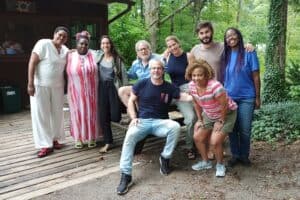
The FIC continues to expand and evolve, responding to the needs of the intentional communities movement. In 2026, in collaboration with the Global Ecovillage Network, they elevated their ic.org platform with more engagement features, including a global map of communities, people and organizations that encompass the IC movement.
The future of the FIC and the intentional communities movement is up to us all. We collectively hold the power to co-create alternative systems for living cooperatively, protecting our planet, and dismantling systems of oppression. Support our work and join our efforts.
This article derives from an excerpt by Sky Blue in 2015. Edits and expansions were added by Harvey Baker and Kim Kanney.