
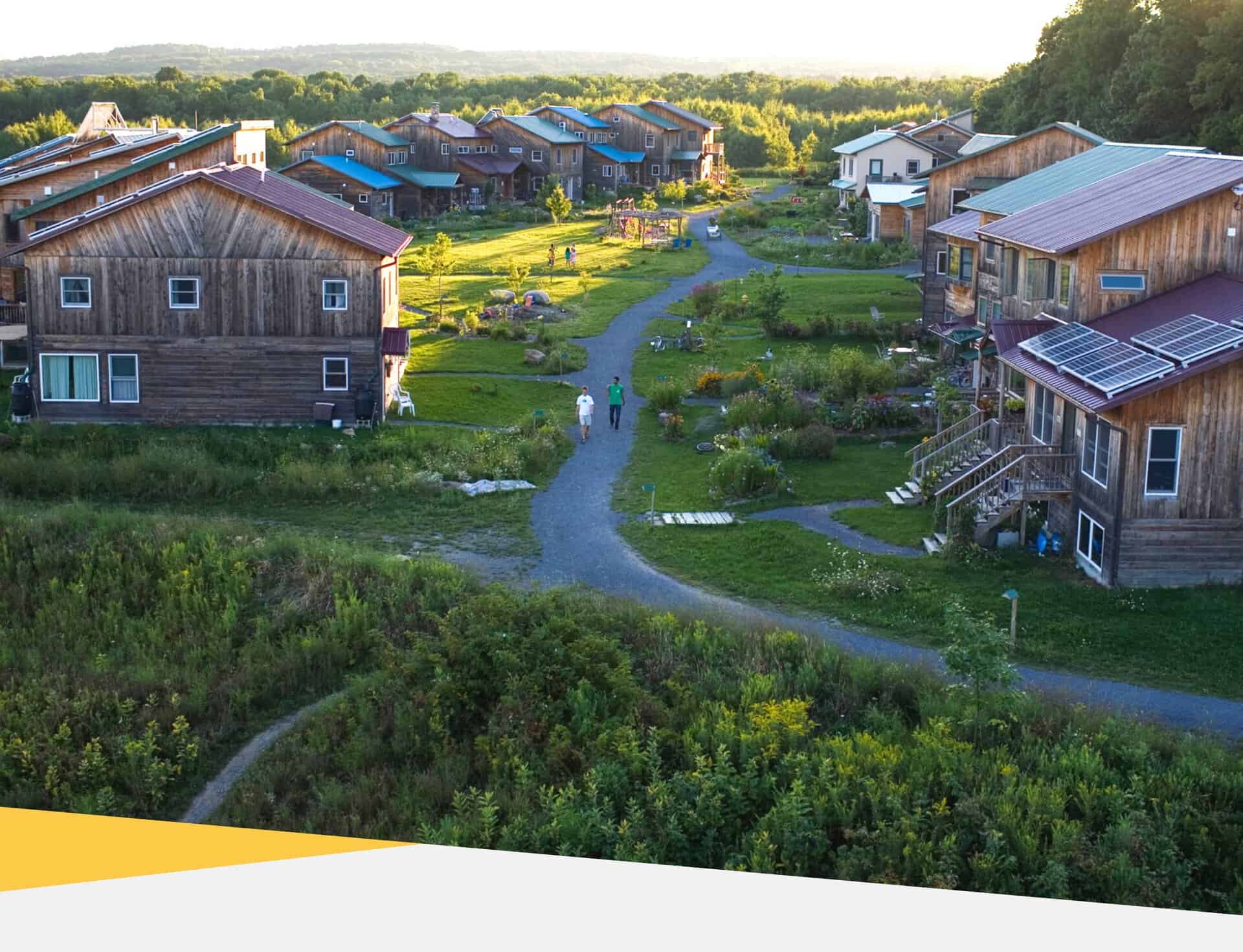
The Foundation for Intentional Community (FIC) defines an intentional community (IC) as a group of people who have chosen to live together or share resources on the basis of common values.
Intentional communities can take many shapes and sizes, from city co-housing to countryside ecovillages. Each one is unique—based on where it’s located and how people live together, make decisions, and share resources. Communities are an opportunity to design daily life around what matters most to you.
Our world is suffering an interconnected crises: ecological collapse, loneliness epidemic, ideological polarity, authoritarianism, inequality and oppression. They are all results of mutually reinforcing systems, operating on a global scale, that perpetuate harm and foster violence.
Intentional communities, on the other hand, offer holistic solutions and a new vision for the future–addressing all of those crises.
They are models for reimagining society, rooted in ancestral and indigenous ways of living based on cooperation, mutual support, and shared stewardship of land – blended with modern technology and approaches for personal and communal transformation.
Social isolation: Social connection is at the heart of community life. By prioritizing emotional support, shared daily life, and authentic relationships, communities create spaces where people feel seen, held, and a true sense of belonging.
Rising housing costs: Sharing spaces and resources like food and tools, and purchasing land as a group, reduces housing costs, making living more affordable.
Environmental degradation: Sharing resources, such as cars and washing machines, reduces individual footprints. Many communities also prioritize sustainability by growing their own food, building natural houses and ecological sewage systems, and using solar energy.
Lack of purpose: By connecting members through specific values, communities provide opportunities for more meaningful and connected lives where each individual is an important part of the collective co-creation.
Inequality: Practicing cooperative economics and post-capitalist alternatives like mutual aid, resource sharing, gift economies, local currencies, and regenerative livelihoods, to reduce reliance on exploitative systems and build economic equity
Power imbalances: Cultivating democratic participation, consensus decision-making, and shared power to create spaces for inclusive, nonviolent social transformation
For most of human history, our ancestors lived in villages, deeply connected to the land, to one another, and to cultural traditions that centered collaboration and care. These ways were systematically dismantled by colonization, and in the past century, capitalism and urbanization have further severed us from our roots—replacing the village with consumerism, and communal care with services to be bought: food, childcare, elder care, medicine, and art.
Yet around the world, communal living still thrives. These ancestral practices, especially within the global majority, offer a powerful blueprint for a future where shared life and land stewardship are reimagined through both ancient wisdom and modern tools.
To learn more, download our free ebook, Starter Guide to Intentional Communities.
Keep the conversation going with these pieces
There are no available blogs
Subscribe to our newsletter for fresh stories and community updates delivered to your inbox.
Get unlimited access to courses, exclusive member events, and a supportive network of community builders
Access all courses, books, and premium content
Member-only workshops and community builders
Member-only workshops and gatherings
We use cookies to improve your experience on our site. By using our site, you consent to cookies.
Manage your cookie preferences below:
Essential cookies enable basic functions and are necessary for the proper function of the website.
These cookies are needed for adding comments on this website.
A residential project: people live here as their primary home.
An institution, business, network, or project that isn’t a residence (e.g. a learning center, farm, or network with no one living there full-time).

{{ item.label }}
{{ item.value ? item.value : currencyFormat( item.amount ) }}
Subtotal
{{ currencyFormat( pricing_summary.total_amount ) }}
There are no results matching your search