
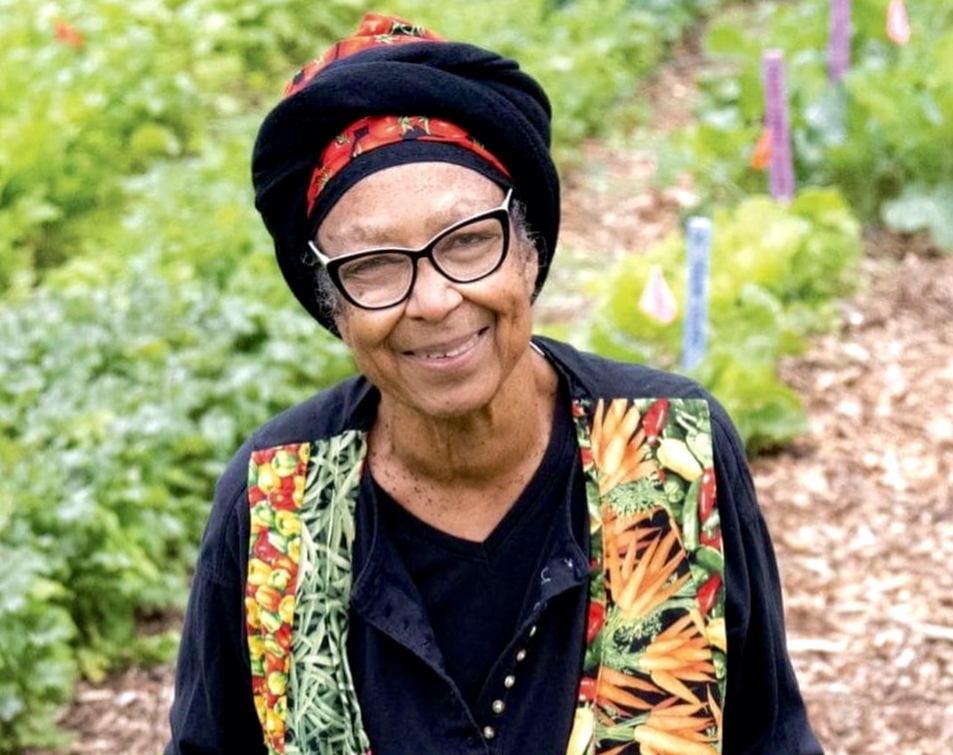
Earlier this year, one of the most respected and well-loved community leaders, BIPOC advocates, and gardening experts was recognized with a most prestigious award. Ira Wallace, 75, received the Lifetime Achievement Award from the Virginia Association for Biological Farming (VABF). Among her award chronicles, she was honored with the Lifetime Service Award at the Sustainable Agriculture Conference. In 2023, she won the James Beard Foundation Leadership Award. The list just goes on…
Founder of Acorn, an income-sharing community based on anarchist principles, and steward of the cooperatively managed seed company, Southern Exposure Seed Exchange, Ira Wallace has been inspiring younger generations who wish to farm and live communally. She is an active part of Ujaama Seeds, a collective of BIPOC growers who cultivate culturally relevant heirloom seeds. For us at the FIC, she has provided guidance in uplifting BIPOC voices and fostering inclusive conversations within intentional communities.
Last week, we got a chance to talk to her and touch on the ups and downs of starting your own business, what her accomplishments mean for BIPOC communities, and how the IC movement as a whole can offer more support to BIPOC communities. Read our interview with Ira below.
The following conversation has been edited for length and clarity.
FIC: What does receiving the Lifetime Achievement Award mean to you? And what do you think it means to BIPOC communities?
Ira Wallace: I sometimes think that in the last couple of years, I’ve gotten a number of awards for the same work I’ve been doing for the past 30-40 years to figure out how we can raise up the BIPOC communities. In agriculture, there are lots of black and brown people who are part of the work, but actually, the people officially in charge are mostly white, even more so than in some other [professional] areas.
So, I feel two ways about it: it’s kind of like being a kid and being desegregated and you had to go out and do the best you can to be a credit to your race, but at the same time, you knew you were lining up for having to be tough, and give other people the benefit of the doubt, or it wasn’t going to work out very well.
FIC: Do you think the awards you receive from these programs support in uplifting other black and brown farmers’ work? Do you think there is a change in this field?
Wallace: Well, in some ways. I’ve been very actively involved in Ujamaa Seeds and Ujamaa Cooperative Farming Alliance, and they have been sharing information, sending people for training, and supporting the Ira Wallace Seed School with their time. There’s nothing in shorter supply than people’s time.
BIPOC people who are trying to be organically certified or involved in the new Rodale Institute regenerative program are getting more support and more information. But still, it’s not straightforward and easy.
FIC: When you were building your business and building communities on your own, do you feel you were supported?
Wallace: Yes, the people who were real allies were supportive, but the culture in the US is so tied to what people have – like, somebody’s dad’s lawyer friend or someone’s architect friend who can help us, and so forth. They would want to be helpful, but that help wasn’t really there in the same way of people they went to college with. But the parents and aunts and uncles of the people who were members also offered support that didn’t cost them anything, but took their time.
FIC: How could intentional communities support BIPOC people starting their own intentional communities or even their own businesses? Is there a clear pathway or actionable items that you see we could be doing more?
Wallace: There’s not a clear way. Like, in the case of Acorn: before, people were much more open to giving funds to BIPOC groups without any restrictions except what you knew about that group that makes you feel trusted that they’re going to do the best that they can.
FIC: Has it been harder to get this kind of support nowadays?
Yes, and no: Some people who are white, who are coming into land they have no real use for and name for, are actually straight up giving it to a BIPOC group or giving it to those who will live there and have a community, or giving it to a broader group to have it in a land trust. So there’s more isolated instances like that, but there are not things like creating more co-ops that help people make a living, I haven’t seen much of that.
There are also few resources for helping people with interpersonal issues that come up in new communities, and old ones that people can count on.
But on the other hand, there are random people who are coming into funds and are putting it toward BIPOC organizations. It’s just a little unclear how in the world people hook up with them. You know, for projects I was doing, someone just gave me some money to be able to give scholarships, someone who I don’t know – I still don’t know them. They asked through another person if that’s something I would do. And then they sent a check. (laughs) And I don’t know how much of that goes on, you know, because they don’t really want it being talked about in a way that people can apply for, it’s more about the people they already trust in making recommendations.
FIC: Is there anything else you think that intentional communities, as a movement, could be doing to support?
Wallace: Well, I think offering possibilities for people to learn skills that are important in community is something that communities could do. I mean, [before], communities that were good at it not only offered it [skills training] to other communities people, but also offered it to the wider community in which they lived. And I think that did the world good. Also technical skills – accounting is the downfall of many a communes.
FIC: Is there anything else you would like to tell when it comes to the recognition you’ve been gaining in these past years about even your role in highlighting bipoc people in communities and in the garden and farming spaces, or also of bipoc communities itself?
Wallace: I have been very excited about the people at Soul Fire Farm – they are making a land trust and looking at different ways for BIPOC people to lead and ways of having access to land and being an example of people who are succeeding and growing food and growing community at the same time. So when I get all bummed out, I read their newsletter.
Keep the conversation going with these pieces
There are no available blogs
Subscribe to our newsletter for fresh stories and community updates delivered to your inbox.
Get unlimited access to courses, exclusive member events, and a supportive network of community builders
Access all courses, books, and premium content
Member-only workshops and community builders
Member-only workshops and gatherings
We use cookies to improve your experience on our site. By using our site, you consent to cookies.
Manage your cookie preferences below:
Essential cookies enable basic functions and are necessary for the proper function of the website.
These cookies are needed for adding comments on this website.
A residential project: people live here as their primary home.
An institution, business, network, or project that isn’t a residence (e.g. a learning center, farm, or network with no one living there full-time).

{{ item.label }}
{{ item.value ? item.value : currencyFormat( item.amount ) }}
Subtotal
{{ currencyFormat( pricing_summary.total_amount ) }}
There are no results matching your search