

In the popular imagination, intentional communities have a reputation for being free-for-alls when it comes to love and relationships. But in reality, that’s rarely the case, and many communities have guiding principles around how members are expected to relate to each other romantically.
Gender dynamics, power imbalances, and more, can all come into play when living in groups of people who may or may not be romantically involved with each other. No one wants to feel pressured to date someone solely to maintain residence in a community, or to keep the peace between opposing viewpoints.
A community’s practices around relationships may be spoken aloud or simply part of the culture. For example, a community might discourage new members from dating each other until they’ve both established themselves as individual members of the community first.
Some communes in history — such as the Oneida commune of the 1800s and Black Bear Ranch in the 1980s — frowned upon “coupling” altogether. For a brief period, residents at Black Bear Ranch were not allowed to spend the night with the same person twice in a row — an experiment that ultimately proved unsustainable.
Modern communities continue to explore new ways to support and facilitate relationship building. Some encourage polyamory or ethical non-monogamy, in which consenting adults have more than one romantic or sexual partner. Twin Oaks, an income-sharing community in Virginia, “has a long, strong history of thoughtful non-monogamy.”
Not every resident practices polyamory, and those that do are expected to avoid becoming dependent on romantic partners: “[E]very adult resident has his or her own bedroom, married or partnered or not, as a way to maintain a semblance of privacy within the context of everything else being shared.”
****
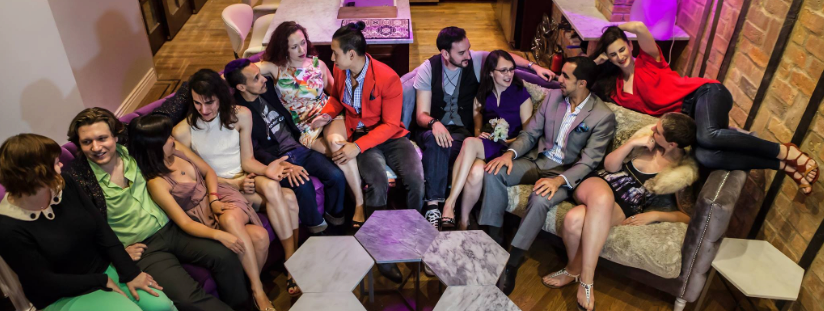
A new community in Bushwick, New York City, called Hacienda Villa prioritizes sex-positive, non-monogamous relationships. The 15-bedroom apartment complex was created as a polyamorous intentional community, although being non-monogamous is not a requirement for people seeking to live there. It’s simply a place where residents can come home and not feel judged or excluded for having multiple partners.
Co-founders Leon Feingold and Kenneth Play stress that residents aren’t all dating each other, and in fact, having sex with roommates is against the community’s policy. Most residents prefer to date outside of the community, and are involved in New York’s wider polyamorous network. The complex doubles as an educational center where residents can host workshops, movie screenings, and sex-positive events.
Anna Bella writes about her experience living at Hacienda Villa in Bust Magazine. She says that open communication is the key to both successful relationships and to intentional living:
“Since I don’t come from a particularly close-knit family, I have sought family everywhere, and this is the place where I’ve found it. Last winter was the first that I didn’t experience seasonal depression, and it was because of my roommates’ kindness on brutal February days. I know that if I’m sick, someone will get me medicine. If I’m crying, someone will hold me until it passes….”
****
What kind of relationships does your community value? Do you have ways to encourage healthy partnerships, and ways to address partnerships that negatively impact the community?
Learn more about Hacienda Villa in the YouTube video below:
Photo via Hacienda Villa
Keep the conversation going with these pieces
There are no available blogs
Subscribe to our newsletter for fresh stories and community updates delivered to your inbox.
Get unlimited access to courses, exclusive member events, and a supportive network of community builders
Access all courses, books, and premium content
Member-only workshops and community builders
Member-only workshops and gatherings
{{ item.label }}
{{ item.value ? item.value : currencyFormat( item.amount ) }}
Subtotal
{{ currencyFormat( pricing_summary.total_amount ) }}
There are no results matching your search