

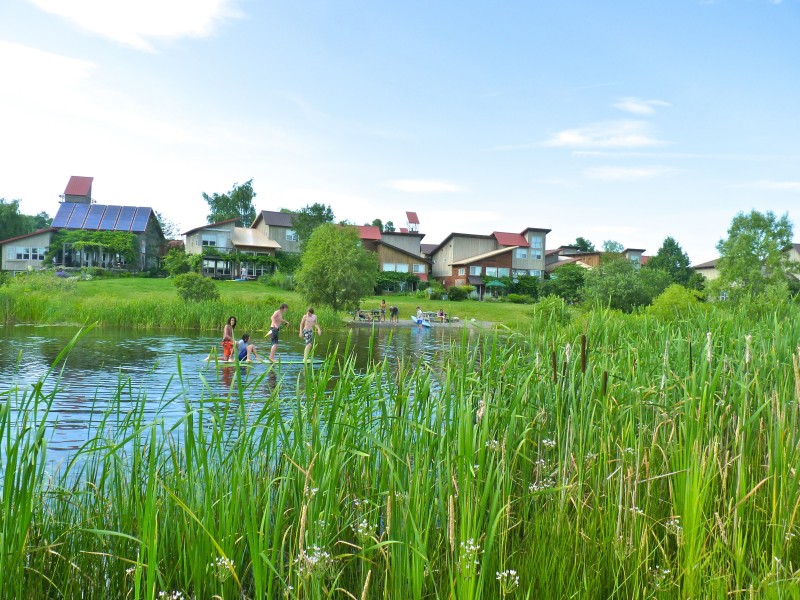
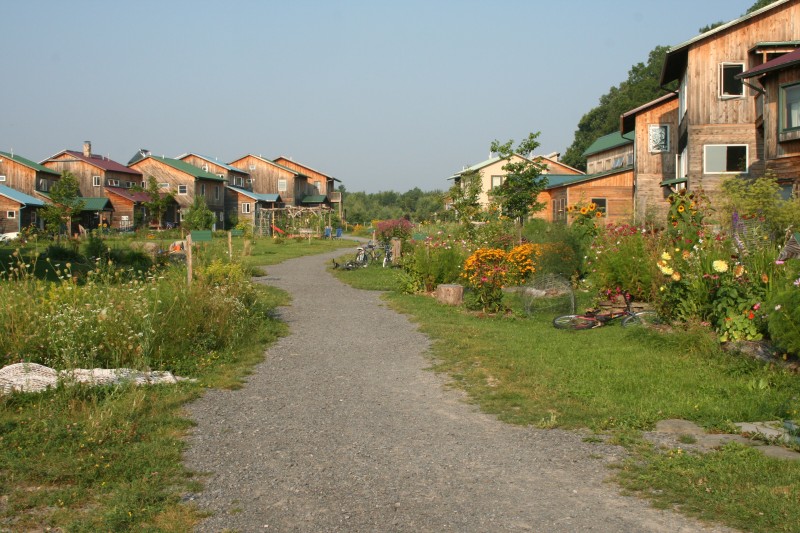
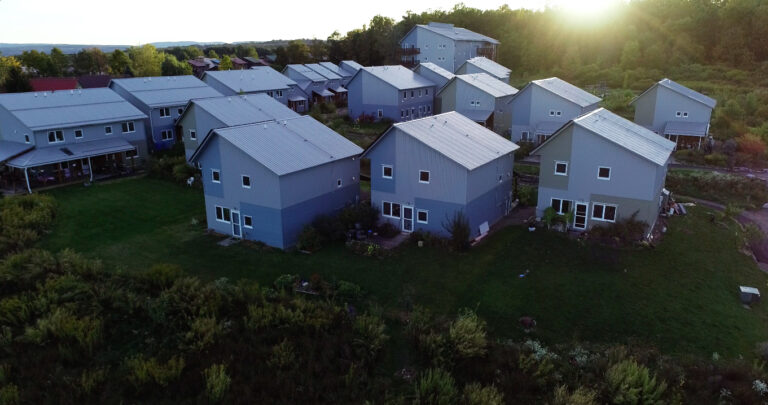
Located in the beautiful region of New York’s Finger Lakes, EcoVillage at Ithaca has three thriving cohousing neighborhoods. The village features cooperative dining in the common houses, a swimming pond, neighborhood community gardens, hiking trails, play spaces, eighty-five energy efficient homes, a common house with 15 apartments, all in a multigenerational village-scale community.
The pedestrian village is surrounded by woods and open meadows. We have a 10-acre organic fruit and vegetable farm on site that provides produce for residents as well as the wider Ithaca area, and a 5-acre CSA berry farm that has delicious organic u-pick berries. We also host a 10 acre teaching farm, the Groundswell Incubator Farm, which offers support for beginning, low-income farmers.
Our goal is to build a replicable model of a cooperative, environmentally sensitive village that can also serve as a demonstration site for teaching principles of sustainability and permaculture.
Our nonprofit educational organization, THRIVE, is affiliated with the Center for Transformative Action at Cornell University. In addition to giving tours to over 500 visitors a year, our developing educational program provides hands-on training in community life, building sustainable communities, and green building techniques for building and planning professionals. We have helped to initiate and contribute to a sustainability movement in our locality that is bringing about profound changes in the region.
EcoVillage is located on 170 acres, two miles from downtown Ithaca, and three miles from Cornell University and Ithaca College. Ninety percent of the land is preserved as green space for organic agriculture and wildlife habitat. For more information about EVI, read Liz Walker’s book, “EcoVillage at Ithaca: Pioneering a Sustainable Culture,” New Society Publishers, 2005. It is available from our website.
Our mission is to promote experiential learning about ways of meeting human needs for shelter, food, energy, livelihood and social connectedness that are aligned with the long-term health and viability of Earth and all its inhabitants.
Those seriously interested in living at EVI should complete our educational process, which involves visiting us, participating in work and social events, reading Liz Walker’s first book, studying our web site, and meeting with the Village Membership Committee. In this way, we assist people to self-select whether living at EVI will be a good fit for them.
Please check our website for information at: https://ecovillageithaca.org/live/
The whole membership decides collectively.
Generally seek agreement, but have backup methods when consensus isn’t reached.
Power and responsibility are shared relatively equally among members.
The third neighborhood is using Sociocracy as a means of governance.
Members maintain separate personal finances with minimal sharing.
Regular fees: Yes
Labor: Yes (2 hrs/week)
Members with pre-existing debt: allowed
Monthly costs include maintenance and upkeep of the property, exterior of all dwellings, and the three neighborhood common houses, plus real estate and school taxes, water, and capital reserve funds. Electricity is metered and billed accordingly. Other additional costs may include Internet access, land line phone service, the Social Justice Fund, and membership in the two non-profit organizations. There may, from time to time, be additional assessments, but these must be approved by the community.
Common House, Garden(s), Library, Workshop, Swimming pond or pool, Large Scale Kitchen, Tractor & Farm Equipment, Fire pit, Swingsets & play areas, Internet
Residential areas outside city centers but within metropolitan regions.
Private homes with shared common facilities, designed for neighborly
interaction while maintaining independence.
Integrated communities designed around ecological principles with sustainable living practices.
There are no needs and offers
{{ item.label }}
{{ item.value ? item.value : currencyFormat( item.amount ) }}
Subtotal
{{ currencyFormat( pricing_summary.total_amount ) }}
There are no results matching your search