

Author: Jennifer Ladd
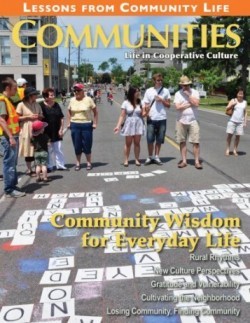
Published in Communities Magazine Issue #159
In this time of peak oil, climate change, and economic instability, many people are looking to build sustainable community close to home and close to their values. This is true for people across the entire class spectrum, including wealthy people. Money can protect one from many things but we ALL feel the effects of climate change, of extreme inequality, and of the breakdown of people-to-people connection, albeit in different ways. Many people with wealth are looking for ways to leverage their resources for good—to help heal the environment and to support the emergence of a new culture based on cooperation and collaboration. And so wealthy people are playing a role, with others, in the growth of intentional communities and other collective working and living projects.
For over two years, I have been facilitating a telephone support group of people with financial resources who have started, want to start, or already live in intentional community-like situations. The conference calls allow people to learn from one another about ownership models, questions of responsibility and stewardship, vision, clear agreements, and power dynamics. The group alternates between having a support group call amongst themselves one month, then having an outside speaker come to the conference call to share information, experience, or expertise the next month.
Members of this group are located in 10 states from around the US. They come from all different kinds of situations: One person has owned land for 20 years and is now interested in attracting others to live, garden, and work together. One person bought land with the intention of living there with community but the community fell apart. Others bought land or buildings with the expressed intention of turning that property over to community over time either in the form of cohousing, land trusts, or cooperatives. Some group members live in the country, some live in cities. One person grew up on a farm that he expects to inherit, at which point he wants to open it up to others. Some have started out with friends to do this, some have started with a spouse, some have journeyed this road on their own with others coming and going along the way.
The taboo of talking about money and class makes this an important topic. Many of us struggle to have these discussions, but in my 20 years of personal and professional experience working on cross-class projects, I have found it is essential to do so. Whether they are made explicit or not, power dynamics, judgments, and fears exist in this area—along with those related to race, gender, ability, sexual orientation, religion, and so on. The more that each person in a community is committed to examining and understanding their attitudes and beliefs about money and class, the stronger that community, or any community-based endeavor, will be.
The individuals who have participated in this group value building a healthy, sustainable world both environmentally and socially. Each person is looking at their particular circumstances and working to understand how he or she can work with others, and with the resource of property, to embody those values.
But it’s not always so easy.
Primary funders can be in control but also feel a great deal of vulnerability as they expose their capacity to fund. Many people have inherited their money. They want to do something of service and they are well aware of how people with a lot of money can be viewed in this time of growing inequality—viewed both with envy/jealousy and with antipathy/resentment. Sometimes they can be seen as an endless source of funding. All told there are distances and differences that need to be acknowledged and grappled with.
Suggestions, Ideas, Considerations
This article is not an exhaustive study of how people with money have started or participated in communities. It is a collection of lessons being learned by this particular sample group—lessons that many others have learned along the way.
1. Encourage early and open discussion of class, money, and power dynamics, realizing everyone plays a part.
Tackle money discussions early on in an open and curious way. Clarify your own values around money, land, and control and ask others to do the same, and then find the structure that embodies those values. Share your class and money stories with each other so you have an understanding of the circumstances and conditions from which you come as you deal with conflict and with moving forward together. Spend time really understanding your own needs and desires for community.
2. If you are someone who already owns property and have a close connection to it, read or re-read the section “When You Already Own Property” (pages 23-24) in Diana Leafe Christian’s book Creating a Life Together.
She writes clearly about the challenges of forming community when there is one sole owner. She writes, “If you’re a property owner seeking to create community on your land…be willing to release total control and find ways for people to become fully participating, responsibility-sharing fellow community members. And if you cannot or don’t want to release full control but still want to live in close proximity with others, please do so and enjoy it—but don’t advertise it as ‘community’!”
Why do some people choose to keep control of the land or property? Well, there are a number of reasons but a primary one is that people have history with the land and care for it. One person has owned her land for many years. She knows its valleys, hills, watersheds, and other resources. She has invested in building a house, barn, greenhouse, and other buildings. She has put a great deal of time and money into a vision and place at which she has much history and many ties. She cares for it deeply. This is also true of another woman who owns land. With others, she has made it a model of sustainability and a place for workshops and retreats. She too has put a lot of money, time, and attention into this land.
Even though both of them feel somewhat burdened by the responsibilities and liabilities and are willing to sell some portion of the land, they feel a great deal of concern for its future care and stewardship and are looking for (and also finding) models of ownership that will assure future care for the land. Members of this group are exploring conservation easements, land trusts, and cooperatives, making the ownership not an individual right/responsibility but a group entity.
3. Be very clear what rights and responsibilities everyone has from the very start.
Most people who own the land/property want to live in community in a way that does not highlight the fact they have the control. They long for a sense of connection and camaraderie. They feel this can’t be done if they have the power of ownership and all that it implies. But, in an ironic way, the clearer one is about what control in decision-making the owner has and what others have, the more trust can be established. At least three people in the group have written agreements with renters about their own rights and responsibilities.
4. If you already own property and want to start a community, be as clear as you can about what part of the property you want to hold on to and what part you want the group to own.
One person took the time to determine this, and that clarity has been a relief for all concerned. She says, “One way to share some power, if you are not willing to give it all over to the group, is to have long-term leases for members. Having some more long-term security will allow others to engage more and feel more empowered. Making sure there are plenty of things the group and/or other individuals decide will help a lot too.”
5. If you have a very strong and clear vision, do your best to be aware of how the strength of your vision both attracts people and potentially disempowers them from contributing their own vision.
Some people have bought land with a fairly well formed vision of building a program, a school, a model gardening place, a place of retreat and renewal. If the land was bought with the express purpose of achieving a particular vision and mission, it can be difficult to maintain a balance between opening the visioning up to others and keeping the main thread of intent. Sometimes founders are so afraid of betraying their own vision that they become rigid, discouraging other potential community members from fully joining in. There may be ways to let others direct some aspect of that vision for which they have passion and expertise.
6. If you are going to start a community, do so with others, not by yourself.
The danger of finding yourself in an almost parental role is high. You will have to hold all the financial and vision responsibility by yourself to begin with and have to navigate the rocky shoals of transitioning and sharing with others. Yes, have an idea, passion, and vision, but start out as early as possible with others if you can possibly do so.
7. If you do start out with others, get to know and form relationships with those with whom you might build community before living in community together. Take your time.
Allen Hancock, who spoke to the group about his experience with Du•má in Eugene, Oregon, said that if he could do it over again he would have spent more time forging relationships with people in the geographical region where he lives—learn what it is like to work together in some endeavor, get to know people over time—then begin the process of visioning and planning together.
8. If you are starting a community with others, find ways to make living together financially possible AND make sure everyone has some “skin in the game.”
It seems to hold true in some people’s experience that when community members can come in easily, they often can leave easily. Find ways for people to make proportionately similar financial commitments. One person may have more money than another but the degree of stretch or commitment can feel comparable. Look for structures that will enable others to gain some form of equity or share over time as you, the primary or initial funder, lessens your ownership—cohousing, cooperatives, creative LLC structures, and community land trusts are options.
9. Hank Obermayer of Mariposa Grove in Oakland suggests that there are five skills/elements essential in building community: Visioning, Time and Time Management, Financial Knowledge, Organizational Development, and People Skills.
Make sure that either you or other core members have these assets and as Hank says, “Make sure that the entire core group trusts those skills in each other. Sometimes you need to accept what others in the core group say, without understanding why, when the others have the relevant skill way more than you.” Very often (not always) the person with the money will also be the person with more time. Be careful about becoming the default primary mover and shaker because of an abundance of money and time. Look for ways that others can also give meaningful time so that the endeavor is more of a co-creation, while being aware that most others need to work for a living.
10. Consider having shared training in decision-making, communication skills, and conflict resolution.
It can be hard to find the time. Whatever is decided, make sure the group who will undergo the training both chooses to do it and finds some way to help pay for it—again this can be done proportionately so that everyone contributes something. Make sure that this is discussed ahead of time.
11. Building a community takes more time and attention than most people imagine when they start the process.
Be aware of what other activities you are involved in and be ready to give up some things so that you have the time and attention to make living together—and whatever project you choose to work on—successful.
12. Have an exit strategy.
Things can change. Every person in a community most likely will have thought about what they might do if they need or want to leave at some point. If you are the sole proprietor or are the one holding the most responsibility for the land, it helps to think beforehand about how you might leave in a way that doesn’t damage the community-like living and working situation. Giving this some thought beforehand may lead you to looking into land trusts or other structures that enable you to follow your life path without disrupting everything that you and others have built along the way.
13. Have a way to get support from others grappling with similar questions, challenges, and possibilities.
I have found that when people are living and working in cross-class situations it is very valuable to have caucus or affinity groups where people can air their feelings and sort out their thinking in order to come back to the group with more clarity and energy to engage.
The people on these conference calls do get support from the people they live with, and it is also very valuable to share ideas with others grappling with similar questions of control, power dynamics, and the confusion of how to live one’s values in such an inequitable world.
14. It is absolutely worth it.
Everyone in the group has waded through difficult times living and working with others, but they are also well aware of the pitfalls of isolation, which wealth can bring. People want to be connected with others, want to share, want to find ways to work together with others. All these experiments have helped people to learn about themselves, have provided them with joyful times, have helped people to be better co-creators of sustainable living that we so direly need at this time in history.
As noted earlier, this is not an all-inclusive or even original set of lessons, but they may bear repeating. The more we can openly, collaboratively, and sincerely search for ways of stewarding land and property and living in community in life-affirming ways, the stronger we all are.
Reference: https://latarde.net/brokers-forex/xm/
Keep the conversation going with these pieces
There are no available blogs
Subscribe to our newsletter for fresh stories and community updates delivered to your inbox.
Get unlimited access to courses, exclusive member events, and a supportive network of community builders
Access all courses, books, and premium content
Member-only workshops and community builders
Member-only workshops and gatherings
{{ item.label }}
{{ item.value ? item.value : currencyFormat( item.amount ) }}
Subtotal
{{ currencyFormat( pricing_summary.total_amount ) }}
There are no results matching your search