

Author: Dona Willoughby
Published in Communities Magazine Issue #153
The corners of my mouth curl up in a contented smile and the warmth that started in my heart spreads throughout my body. I am lying in bed with my napping three-year-old listening to chomping and rustling sounds outside my window. Getting up, looking out, I see two small wild pigs. They’re foraging for food in the purple sweet potatoes we use as ground cover. I am reminded of my wild pet pigs, Bear and Summer—among the many experiments that comprise my current life living in a permaculture community on the Big Island of Hawaii.
My life here is conscious participation in myriad experiments—some of which I am aware of right now and others which will be revealed as time moves on. This constant education program is evidence to me that we are “Doing it.” Permaculture is the harmonious integration of landscape and people providing their food, shelter, energy, and other material and non-material needs in a sustainable way. On a daily basis, we immerse ourselves in the questions and actions it takes to need fewer and fewer inputs from the outside world.
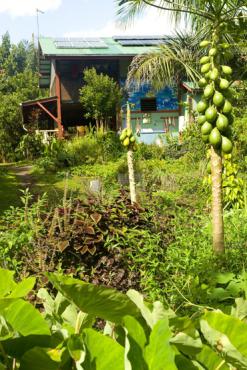
Heart of palm salad, stewed wild boar with taro and beyjool seeds, baked orange squash, an enormous leafy green salad with kale, topped off with a banana cassava cake, scrumptiously fill stomachs with a local dinner. Food, a primary focus of our sustainability efforts, averages about 70 percent from our land. The leafy greens and the annual vegetables come from an organic garden with raised beds. The remainder comes from food forests which mimic natural ecosystems. Tall palm trees coexist with shorter fruit and nut trees and bananas, interplanted with spindly cassava plants, berry bushes, kava, coffee, and cacao. Vanilla orchids and air potatoes climb up the trees. Squash grows around the edge of the food forest.
Six years have passed since La’akea changed hands and became an intentional community. During this time, many of the members have taken and presented permaculture classes. We’ve obtained, planted, and given away plant cuttings, observed them for their possible applications, developed recipes.
Three years ago, several members dedicated a month to eating 100 percent locally, from the big island. While they were successful, one challenge was getting enough starch. What to eat if not rice, wheat, or other grains? Grains do not grow well in the tropics. So the fourth year we opened our eyes to alternative starches. We already had taro, and to this we added cassava, peach palm fruit, air potatoes, squash, and beyjool seeds. Year five, two of us went 100 percent local again. The diet nurtured us psychically and physically, producing very little non-compostable waste. After six years, we have enough food to survive. The land is not lacking. It is our taste buds and preferences for what is familiar that need to change. Harvesting and preparing foods from the land requires labor. Efficiency could be greatly increased if more members, including myself, were ready to make the switch.
Our members are a group of people who do not come from a sustainable culture. Most of us weren’t breast-fed. We’ve been surrounded by plastics and disposable commodities for significant portions of our lives, and have had access to fossil fuels since birth. Difficulties arise as we challenge norms and habits acquired from our past. We encourage feelings to come to the surface. Repressed anger may give birth to loud voices and tears. Our local Kilauea volcano provides an excellent example of the benefits of not holding back. By constantly releasing small amounts of hot red lava, it avoids tumultuous explosions. Sitting together, every Thursday evening, sharing, listening, touching, at our “heart shares,” we create space for emotional expression. Clearing the slate, through periodic emotional release, simplifies communication with oneself, other people, and other species. The often-neglected zone zero (emotional health), the home of personal growth, is vitally important to our permaculture system.
In addition to our heart shares, we have found a variety of “tools” to assist each other in creating a supportive environment. These include Compassionate Communication (NVC), Peer Counseling, Huna, parental support meetings, and daily check-ins. Every morning we meet to share 10 to 20 minutes over breakfast. During this time, individuals share their present emotional condition as well as their hopes for the day. This serves us both logistically and socially. At this time anyone may express a need or desire for additional support, whether it be with a physical activity or an emotional process. This daily meeting is not mandatory. We attend most of the time knowing how beneficial it is to our functioning as a cohesive family.
We all have areas of life for which we feel passion and that give us purpose. These passions bring forth individual talents which are offered to the community, and move us further toward sustainability. The use of our talents makes us better stewards of our piece of the Aina (land) and moves us toward more loving intimate relationships.
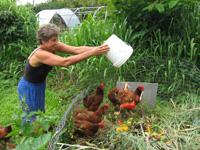
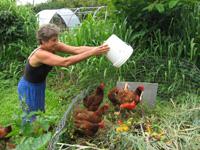
For instance, some of us are chicken folks. We have an 81-year-old and a three-year-old member who both seem to have a special affinity for those wonderful birds. The chickens keep our compost pile turned and produce eggs/fritatas aplenty for community members.
Several of our members are now sheep specialists. When we arrived at La’akea, the jungle was higher than the fruit trees in our orchards. Foliage in a rain forest grows very fast. Saws and weed whackers were wasteful and intensive not only of fossil fuel, but of human energy. So we partnered with sheep to keep the orchards mowed and fertilized, and the nitrogen-fixing trees under control. Maintaining just the right number of sheep so pastures are not overgrazed is a talent that one of our members has developed. This member also developed the spiritual and emotional capacity to part with beloved sheep, butcher them, and serve them to La’akea meat eaters.
Other talents required are repairing and construction. We could have continued living in the huts and several buildings available at La’akea when purchased. However, moldy clothing after a week of daily rain, sharing your hut with a rat (also seeking dryness), and getting into moist blankets at night all get old. We now live in spaces that can be kept dry when it’s rainy, and rat-free. One such space is a beautiful octagon building recycled from a nearby subdivision. It was moved to La’akea piece by piece and reassembled by members and work traders, instead of ending up in landfill. Four other dry homes were constructed, some using rocks and trees off our land. Our homes are really just bedroom cabins, since the kitchen, office, yoga room, living spaces, shower, and toilets are communal.
So are we doing it? What is the measure of sustainability? If we look at the five garbage cans headed for the dump, or the contents of the recycling center, one could easily say we are not there yet.
It may be said that if we want to change our future we have to change the substrates of our culture—the food, the entertainment, the tools, the art, and much else. This is a process, one experiment after another, one small step after another. In this sense we are doing it.
While we do not have a common vision for where we are going, we are all clear that we want to be less dependent on non-sustainable, non-local products. While there is no clear structure for getting from here to there, we want to help one another be more conscious about what is going on—within ourselves, within our group, within the larger world—and support one another .
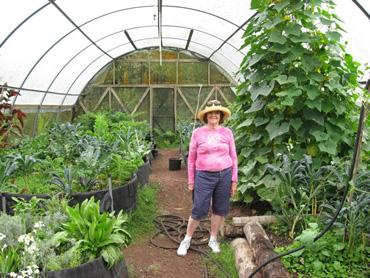
By the way, did you wonder how the pet pig experiment, mentioned in the first paragraph, ended? The plan was for them to be living rototillers. After their third break-in and rooting destruction of the garden beds in our greenhouse, we relocated them to Green Lake, a beautiful wild area. I missed giving them coconut oil massages, but my partner Biko and I created a beautiful human baby to nurture and love.
Keep the conversation going with these pieces
There are no available blogs
Subscribe to our newsletter for fresh stories and community updates delivered to your inbox.
Get unlimited access to courses, exclusive member events, and a supportive network of community builders
Access all courses, books, and premium content
Member-only workshops and community builders
Member-only workshops and gatherings
{{ item.label }}
{{ item.value ? item.value : currencyFormat( item.amount ) }}
Subtotal
{{ currencyFormat( pricing_summary.total_amount ) }}
There are no results matching your search