


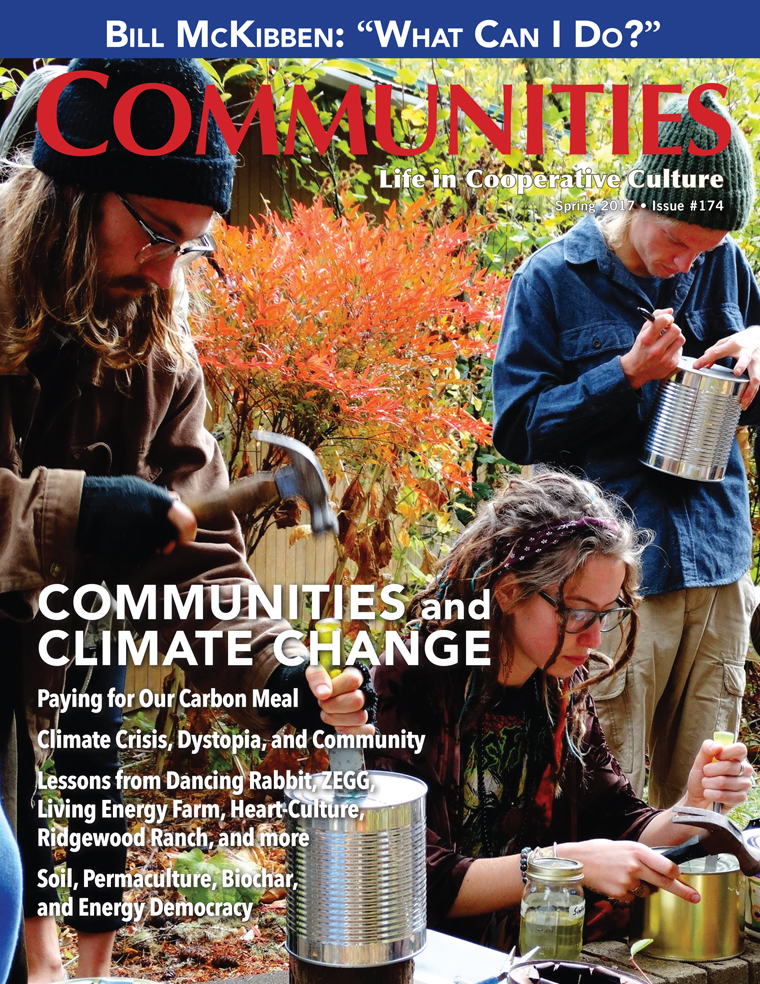
Issue #174 ● Spring 2017
The Question I Get Asked the Most By Bill McKibben
“What can I do?” It’s the right question—almost.
Living Energy Farm: An Answer for Climate Change By Alexis Zeigler
A fossil-fuel-free community empowers its members to dramatically reduce their dependence on the corporate economy.
Limiting the Damage of Climate Change: Lessons from Dancing Rabbit By Ma’ikwe Ludwig
Committed communitarians cut their carbon emissions to around 10 percent of the American average.
Soil, Communities, and Climate Change: An Interview with Nikki Silvestri By Chris Roth
As a climate solutions advocate explains, carbon is not a bad thing; it’s just in the wrong places right now.
Addressing Climate Change: Two Generations at Heart-Culture Farm Community By Kara Huntermoon
For the next generation, planting trees, growing food, and living in community are only the start.
Permaculture, Community, and Climate Change By Tom Henfrey
Community-led action, with permaculture as a key tool, is the basis for many of the most innovative and effective responses to climate change.
Ridgewood Ranch: A Mecca For Adaptive Community By Steve Hellman and Daniel Spiro
Numerous projects on a community’s 5,000 acres contribute to climate-adaptive land stewardship.
Variations on a Theme: Low-Carbon Communities of All Sorts By Ma’ikwe Ludwig
Three innovative non-residential groups use community as a tool to address climate change.
Hurricane Lunch: Global Warming Affects Island Nations By Philip Mirkin
A community in Fiji responds to a category one hurricane—a taste of events yet to come.
Local Solutions to Global Warming: Paying for Our Carbon Meal By Daniel Greenberg
Compared to carbon offsetting, carbon onsetting may be a more effective strategy to build sustainability.
Intentional Electricity: The Challenges and Rewards of Community Power By Woody Hastings
In Community Choice Energy agencies, we are witnessing the emergence of Energy Democracy.
The Carrot in Front of Our Nose: Lessons from ZEGG By Tobias Bayr
Life in an ecovillage demonstrates that less can be more.
Communities and Zero Population Growth By Arty Kopecky
Cooperative culture helps us evolve beyond the nuclear family toward conscious kinship and reconnection with the land.
Preparing for the Human Challenges of Climate Change By Sara Donna
Deteriorating social and environmental conditions require both spiritual preparation and practical steps.
Twenty Principles of Ecoresilience: Personal and Cultural Adaptation to a Changed Planet By Linda Buzzell and Craig Chalquist
How do we strengthen communities as climate change intensifies?
Affordable, Developer-Driven Ecovillages: Meeting an Unmet Need By Mac Maguire
A replicable ecovillage model is our best hope for achieving essential, global-scale changes.
● Neighborly Questions and Critiques
Wurruk’an: An Experimental Intentional Community By Bill Metcalf
A book on “life beyond industrial civilisation” inspires the creation of an ecovillage.
Letters
Publisher’s Note No Hope? By Sky Blue
The situation may appear hopeless, but what we do together can transform the world.
Notes from the Editor Climate Crisis, Dystopia, and Community By Chris Roth
From the personal to the global, with hard times undeniable, community may be our life-support.
Review Permaculture and Climate Change Adaptation By Amelia L. Williams
A new book offers grassroots strategies for responding to climate change.
Keep the conversation going with these pieces
There are no available blogs
Subscribe to our newsletter for fresh stories and community updates delivered to your inbox.
Get unlimited access to courses, exclusive member events, and a supportive network of community builders
Access all courses, books, and premium content
Member-only workshops and community builders
Member-only workshops and gatherings
{{ item.label }}
{{ item.value ? item.value : currencyFormat( item.amount ) }}
Subtotal
{{ currencyFormat( pricing_summary.total_amount ) }}
There are no results matching your search