

Article originally published at http://cynthiatina.com/
“I came to Camphill thinking I was going to learn about social therapy for people with special needs, but then I learned it’s actually mainstream society that needs the social therapy,” a Camphill resident shared on stage during an opening plenary for the International Communal Studies Association (ISCA) Conference, hosted July 18-21, 2019 in upstate New York. The ICSA Conference takes place in a different part of the world every three years. The theme for this year’s conference was both timely and potent – Diversity and Inclusion in Intentional Communities.
There’s perhaps no better place to host a conference on this theme than at the Camphill Communities. Camphill is an international movement of intentional communities designed to meet the needs of children, youth and adults with developmental disabilities through a combination of community life, the arts and work on the land. There are currently over 100 Camphill communities in 22 countries.
Each community has a distinctive character and focus, while supporting the overarching vision of Camphill, “relationships of mutual respect, education and (or) meaningful work, real participation in community life, a stress-reducing rhythm of daily activities, seasonal celebrations, a rich artistic and cultural life, natural therapies, and acceptance, individual recognition, and dignity for everyone,” according to the Camphill Association of North America.
The four communities that hosted the ISCA Conference are all within driving distance of Hudson, New York. Camphill Village USA, also known as Camphill Copake, is one of the two original Camphill Communities in North America, founded in 1961. Triform Camphill Community is a youth guidance community that provides special support to young adults with developmental disabilities. Camphill Hudson is an urban community that is immersed in the lively culture of the city of Hudson. And Camphill Ghent is an elder community providing supportive care to older adults of all abilities.
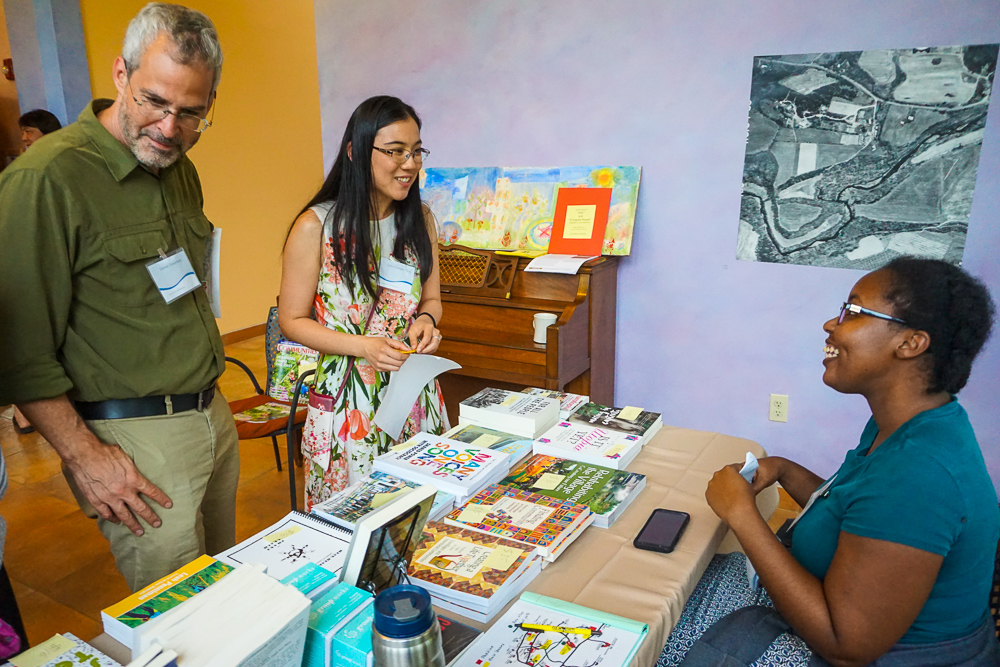
Set amongst tall forests in the peak of summer lushness, over 200 people from around the world gathered in this rural part of upstate New York to explore strategies for the inclusion and empowerment of persons with diverse abilities, cultures, races, economic backgrounds, religions, ages, genders, and sexualities. A large number of participants were academics and researchers studying intentional community. Others live in intentional community or are interested in visiting/starting a community project.
Many attendees were hosted in Camphill residential homes during the event. The homestay experience was a glimpse into the unique nature of the Camphill model. People with disabilities live alongside international families of “coworkers,” who serve not as their caretakers per se, but as learning peers, colleagues, and friends. These homes operate like extended families, fully integrated into village life.
The day starts with a morning circle and breakfast together. Then everyone heads off to school or work in one of the many small workshops, business, and farms onsite. Life is shared together in a way that supports the flourishing of each individual, regardless of ones level of ability and needs. It’s touching to witness the joy and connection amongst residents, especially in contrast to more conventional models of dealing with disabled persons. During the conference we learned that people in mainstream care often don’t have a single friend beyond their family and caretakers. They also have life expectancies shorter than the average life of a Camphill resident.
While persons with disabilities may be some of the most marginalized members of society, the Conference also addressed broad issues of inclusion.
Yana Ludwig spoke during the opening night, expounding how critical it is that we all take action to understand our privilege and work to dismantle systems of oppression. She makes the link between racism and one of humanity’s most pressing challenges, climate disruption. She points to the lack of strong action from white leaders in the Global North (especially the US as one of the leading carbon emission emitters) as a form of racism towards those in the Global South (who bear the brunt of climate catastrophe while having done the least to contribute to it). Yana asserts us that diversity and inclusion isn’t an end goal, but rather the beginning of a process towards a more just and sustainable future.
As microcosms of (and alternatives to) mainstream society, can intentional communities help us understand ways to shift out of systems of oppression?
Another panelist speaker, Luther Smith, from L’Arche (another network of communities similar to Camphill) reminds us that while intentional communities can serve as practice grounds for the kind of inclusion we’d like to see in larger society, we shouldn’t be disillusioned into thinking that “the more we get together, the happier we will be.” The practise of inclusion can come with as many challenges as opportunities.
The numerous workshops, panel papers, and plenary sessions throughout the four event days focused on different aspects of diversity in intentional community as well as offered practical tools for fostering inclusion. The Conference organizers “walked-their-talk” by giving prime speaking time to people with diverse abilities, varied backgrounds, skin colors, and sexual orientations. The margins came to the center during this momentous gathering.
The ISCA works to provide a common framework for a scholarly exchange of information regarding communal life; communes, intentional communities, kibbutzim and other collective communities throughout the world. To learn more and find out about the 2022 Conference, visit
http://www.communa.org.il/icsa/
The 2019 ISCA Conference was an event sponsored by the Foundation for Intentional Community (FIC). During the gathering, FIC awarded Diggers & Dreamers as the 2020 recipient of the Kozeny Communitarian Award. To learn more visit https://www.ic.org/diggers-dreamers-2020-kozeny-award/
Keep the conversation going with these pieces
There are no available blogs
Subscribe to our newsletter for fresh stories and community updates delivered to your inbox.
Get unlimited access to courses, exclusive member events, and a supportive network of community builders
Access all courses, books, and premium content
Member-only workshops and community builders
Member-only workshops and gatherings
{{ item.label }}
{{ item.value ? item.value : currencyFormat( item.amount ) }}
Subtotal
{{ currencyFormat( pricing_summary.total_amount ) }}
There are no results matching your search