

What’s the difference between a cult and a community? How, when seeking community, can you avoid hooking up with a cult?
I can’t answer these questions with certainty or authority—but I can offer some relevant insights, drawn in part from my involvement, over the past twenty years, with a cult, a community, and something in between.
In 1999, fresh out of Harvard and eager to flee the matrix, I boarded a Greyhound bus from New York City to Western North Carolina, to visit Zendik Farm. I’d found the Farm in The Communities Directory; I expected to stay two weeks.
Instead, I stayed five years.
At Zendik, I had no money of my own. I slept mostly in co-ed dorms, and kept my scant belongings in my fully exposed “space.” Each day, from morning till night, I hopped to whatever mission Arol—our matriarch—had given priority. Unless I was pooping (in the outhouse), doing an enema, or engaging in an “Erosolo” (a “date” with myself—more on “dates” later), I had no valid reason to be alone.
If I wanted a new toothbrush, I put it on the shopping list, and Fawn—Arol’s daughter—decided if it was okay for the shoppers to get one for me, that week, on their all-day trip.
If I wished to explore a sexual attraction to a man, I asked a third party to “hit him up,” on my behalf, for a “walk” (involving hanging out and making out but usually not nudity or sex) or a “date” (sex). Then, if the man said yes, and we were going on a “date,” I arranged for a “date space” (a tiny shack just big enough for a double bed and a nightstand), and got “specked” (checked with a speculum) to see if I could “ball” (have intercourse). With rare exceptions, “balling” while fertile was prohibited.
To make money, many of us Zendiks went on road trips, every other weekend or so, to sell our self-produced magazines, CDs, and “STOP BITCHING, START A REVOLUTION” stickers and T-shirts. We hustled all day, and into the night, to meet unofficial quotas; when we returned to the Farm, we delivered all we’d made (less the cost of incidentals like gas and ice) to Arol or Fawn.
We called the outside world “the Deathculture”; we believed it was okay to lie to, cheat, and steal from non-Zendiks, since we were saving the world—by creating a new culture, based on cooperation and honesty—and they weren’t.
Internally, we worked relentlessly to eradicate our “Deathculture conditioning”; following Arol’s lead, we bashed each other for sins of omission and commission, as well as thought crime. When someone (of lower rank) was suffering, she could expect to be asked, “How’d you vibe into that?”
Woven together, these patterns formed an etheric fortress within which Arol played god: she created and destroyed relationships, pressured women to have abortions, bestowed and clawed back positions of responsibility, decided what was and wasn’t art, welcomed people in and kicked people out. She also told us, over and over, who we were. She never thought to ask.
After I was exiled from Zendik, in 2004—with my backpack, ten dollars, and a ride to the highway—I desperately needed a safe haven. So I retreated to Silver River (not its real name), a remote homestead east of Phoenix, Arizona where I’d stayed twice before, for short periods, in the late ’90s.
This time, I stayed three months—under a benevolent dictatorship, exemplified by the following scenelet:
Silver’s founder has called a “family meeting” to address an alleged trespass by one of the other three interns, all young men. Holding the feather he’s designated as talking stick, he holds forth, vehemently, and at length; then, having passed the feather on, he interrupts and shouts down the young man holding it.
Power imbalance was built into life at Silver. The founder had been there more than twenty years, to the interns’ mere months. He was a few decades older than us, and far more experienced. What little cash came in—from classes, donations, and sales of produce and herbal remedies—was his to disperse. He took full responsibility for the place, and full authority over it. This was an honorable stance. But it didn’t jibe with passing the talking stick.
Also, the founder was wonderfully generous, and open to an easy flow of comings and goings. At Silver, I enjoyed a day off each week, got to stop working after dinner cleanup, and managed to save some money—serving as cook and office manager—that helped me transition to my next gig. And I felt deeply appreciated—not only for my work, skills, and talents, but for my essence. My self. Though I did feel entirely free to leave, I did not feel expendable—as I had at Zendik.
If Zendik bound my wings to my body, so tightly and for so long that they fused with my ribs, then Silver provided the snug nest I needed to survive as a fledgling while growing new wings.
After discovering, in 2005, that Zendik was a cult, I decided that the whole group-living thing—in all its forms—was bullshit. And/or a recipe for unhealthy isolation. And/or simply not for me.
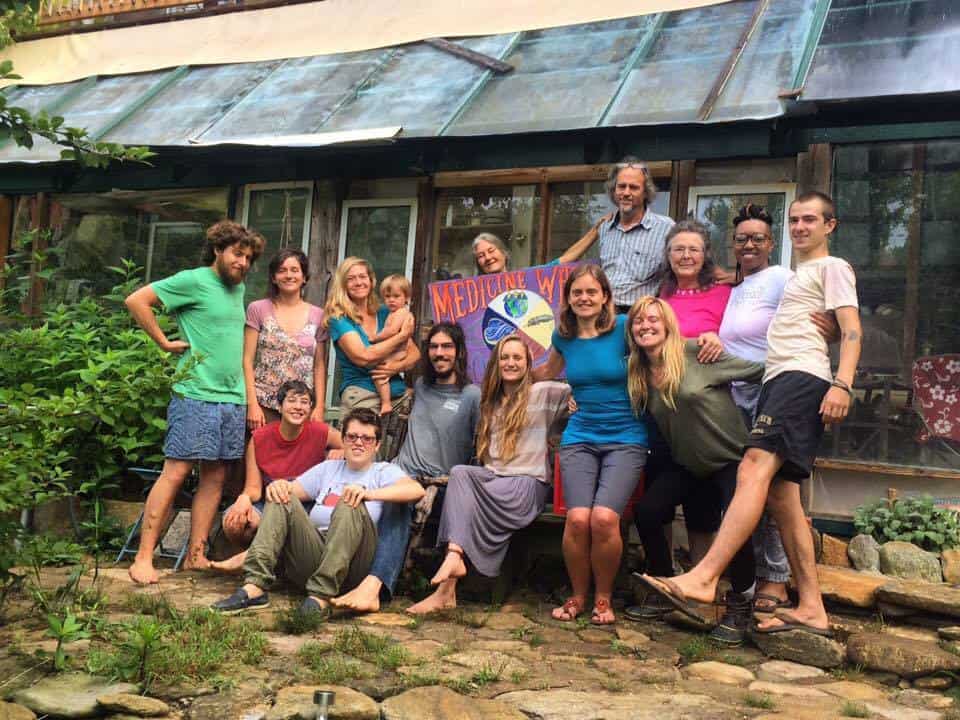
So when I visited Earthaven Ecovillage (also in Western North Carolina, not far from where Zendik had once been), in winter 2016, I was excited and curious, but also sniffing for signs of hypocrisy. I wasn’t prepared for the feelings of warmth, welcome, and home I encountered at Medicine Wheel—my place to stay, and the most communal of Earthaven’s dozen or so neighborhoods.
Medicine Wheel seemed to run on a combination of true competence at off-grid living and true care for each member of the collective. Plus, it incorporated some of the more positive aspects of Zendik—the camaraderie of shared work, the hilarity of extreme challenge, the intimacy arising from frequent, casual contact. What a perfect antidote to the stark loneliness of the single-family house my husband and I had just bought in the Hudson Valley! After that first visit, I arranged to return, for two months, in the spring.
Since then, I’ve come and gone from Earthaven a number of times—and spent enough time there to be able to articulate what makes it a true—and healthy—community.
When I’m at Earthaven, I have clear responsibilities: I owe Medicine Wheel attendance at weekly house meetings; set amounts of money for food, rent, and Internet; and clearly delineated investments of time and energy in cooking, cleaning, and homestead upkeep. I owe Earthaven a monthly fee, plus a set number of hours of service. I’m free to earn money however I choose.
Since I still live most of the time in the Hudson Valley (now in a wonderfully cozy single-family home), I have yet to pursue membership in Earthaven. However, if and when I do, I’ll be stepping into a clearly defined process, involving additional financial commitments and service requirements, as well as the chance to join in decision-making: all full members may vote on matters considered in twice-monthly Council meetings, while provisional members may participate without voting. (Non-members may sit outside the Council circle and observe.)
It doesn’t hurt that Earthaven was founded—and initially financed—by a group, holding a polycuture of beliefs, rather than a single leader, preaching the Truth; from the beginning, power was shared. And, while most Earthaveners hold a strong critique of business as usual, they also embrace a degree of porosity, and maintain a wealth of reciprocal relationships with the outside world.
If you’re my age or older, the word “cult” may conjure images of Jonestown, Waco, Heaven’s Gate. If you’re a Millennial, it may bring up—what? NXIVM? Wild, Wild Country? The Unbreakable Kimmy Schmidt? Either way, you most likely—as I once did—define the word by association.
Sociologists who’ve studied “high-demand groups,” on the other hand, have attempted to limn the term via lists of criteria. These include: no appeal to a power higher than the leader, tight control over members’ behavior, a double moral standard (pairing, for example, pressure for honesty within the group with permission to lie to outsiders), an “us-against-them” mentality (we’re saving the world; you’re destroying it), and contempt for those who’ve left.
I respect these criteria, and find them useful. It was a book informed by the work of these sociologists—Combatting Cult Mind Control, by Steven Hassan—that cemented my mental-emotional freedom from Zendik (more than a year after I’d left) by showing me that it was not a unique revolutionary movement, in the vanguard of human development, but yet another retread of an age-old scam. However, since it’s not easy to remember the entire list, much less trot it out at parties, I’ve developed my own, more basic definition of a cult: a set of interlocking patterns that combine to strip the individual of self-trust.
For example: at least a couple times, at Zendik, something Arol said or did enraged me. Did I admit this? I did not—in part because doing so would have meant risking home and family. How’s that? Well, I’d pretty much rejected my birth family—incubator, I believed, of my “Deathculture” corruption—and I had no money of my own. So—forget starting over. Much better to swallow my fury, beat a tree till my palms bled, and keep on following the leader.
And yet: I see no bright line dividing cult from community. I believe that all groups occupy a continuum, from respect to contempt for self-trust, and that the best you can do, when vetting a group, is ask probing questions and then—if you get only surface answers—recognize them as such and probe some more.
If you’re looking for a community, visiting one, or thinking about committing to a group you’ve already gotten to know, you might want to find out:
• How the group views other groups, and the culture as a whole. To what extent do members respect and collaborate with outsiders?
• What happens to members’ pre-existing relationships with people outside the group, once they join. Do these ties weaken? Thrive? Disappear? Are members pressured to drop, or limit contact with, former associates?
• What support, if any, accrues to long-term members who leave. How do they transition to the next stage of life? How do group members view, and talk about, those who’ve departed?
• Who controls the money and owns the land. Whose names are on the deed? The bank accounts?
• How money flows within the group. How would a member procure a new toothbrush?
• Whether the group has governing documents. If so, can you review them? What do they say?
• How free members are to set their own schedules, spend time alone, invest energy in personal projects.
• What kind of access members have to books, music, periodicals, phone service, the Internet, etc. How free are they to interact, as individuals, with the outside world?
• How well the group equips children raised within it to transition out, should they choose to leave.
A caveat: this list is by no means authoritative, or complete. Like the rest of this piece—and my Zendik memoir, Mating in Captivity—it is simply an attempt to compost my own experience into fertilizer you can use, to grow a healthy community home.
Helen Zuman’s memoir, Mating in Captivity (She Writes Press 2018) was named a Kirkus Best Indie Book in 2018, and a finalist in Creative Nonfiction for a 2019 Firecracker Award. She has contributed writing to Communities magazine, and currently writes a column called “On Villaging” for Livelihood. To read more—or listen to Undercurrents (her occasional podcast), or buy a signed copy of Mating in Captivity—please visit helenzuman.com. And, if you’re tempted to get in touch—with a comment, question, riddle, limerick, story, or song—please do! Find Helen on Twitter (@HelenZuman) or email helen@helenzuman.com.
Keep the conversation going with these pieces
There are no available blogs
Subscribe to our newsletter for fresh stories and community updates delivered to your inbox.
Get unlimited access to courses, exclusive member events, and a supportive network of community builders
Access all courses, books, and premium content
Member-only workshops and community builders
Member-only workshops and gatherings
We use cookies to improve your experience on our site. By using our site, you consent to cookies.
Manage your cookie preferences below:
Essential cookies enable basic functions and are necessary for the proper function of the website.
These cookies are needed for adding comments on this website.
A residential project: people live here as their primary home.
An institution, business, network, or project that isn’t a residence (e.g. a learning center, farm, or network with no one living there full-time).

{{ item.label }}
{{ item.value ? item.value : currencyFormat( item.amount ) }}
Subtotal
{{ currencyFormat( pricing_summary.total_amount ) }}
There are no results matching your search