

The following piece is adapted from one first written for a new book on Low Impact Development published by the British group Diggers and Dreamers.
Most houses in the eco-communities I’ve researched are built by men. This article explores why this matters and some ways that women have started to reclaim the task of building their own homes.
Gender is just one form of difference between us; we also differentiate ourselves by race, class, sexuality, size, and many other markers. But when it comes to examining how houses are built in eco-communities, the biggest divide I’ve seen is around gender. Despite the feminist movement, significant gains in equality between genders in the last century, and the fact that eco-communities tend to be politically left and liberal, the gender politics of building often go ignored.
I’ve witnessed men dominate building in eco-communities through a mixture of blatant and subtle ways, though with all generalisations there are important exceptions. This article is not a tirade against men; rather it explores how both men and women involved in eco-communities struggle to overcome gender as a form of division, and how this has consequences for both genders. By ignoring gender as an issue we are potentially excluding a wealth of knowledge and labour from eco-building. Gender should not be a barrier to being a builder, but neither can it be ignored. Exploring gender requires us to look at the social aspects of housing as being as important as the physical structure, and thus including more women might also change how our homes are built.
I have been researching and working with eco-communities for the last decade. In particular I conducted a research project comparing British eco-communities with those in Spain, Thailand, Argentina, and the US, visiting 30 different communities overall. My interest is in how houses in eco-communities get built, the decisions, choices, and dilemmas involved, the costs (social and emotional as well as economic), the compromises, and how the completed house is lived in, works, and functions—in other words, the social practices through which housing is built and lived in.
This approach is vital in order to understand why we do not have more eco-houses. We already have the knowledge, technology, materials, built exemplars, and often the finance, and yet few people choose to build, or even live in, an eco-house. If we can examine what drives those people who do build eco-communities and how their choices are made, then we would be better able to encourage others to do the same.
There are some interesting historical examples of women being actively involved in house building. In the Pueblos of New Mexico (US) indigenous women led house building. Although the men erected the main timbers, women did everything else, including being responsible for physical maintenance of the buildings [Crews, C (2010) Clay Culture: Plasters, Paints and Preservation. Gourmet Adobe Press, New Mexico]. In the US in the 1970s the feminist movement fought to challenge the mainstream ways of building houses and instead designed kitchenless houses as a way to free women from their domestic burden [Hayden, D (1981) The Grand Domestic Revolution: A History of Feminist Designs for American Homes, Neighborhoods, and Cities. The MIT Press, London]. At the same time many eco-communities emerged in that era with increasing numbers of women trained as carpenters and builders, and women were heavily involved in construction of their own homes.
Assumptions about Women
Throughout my travels through many eco-communities I rarely met a female eco-builder. Even so, when I raised the issue of gender many people denied there was a problem, instead asserting that the lack of women on build projects was a result of women’s personal choice. Gender exclusion today is rarely blatant; it tends to rely on often quite subtle assumptions made about women’s minds, bodies, and roles in society, which are then reinforced by both men and women repeating and performing those roles.
People might not even realise that they are being sexist in voicing these assumptions, and women might not believe that their “personal choices” are influenced by such assumptions. Yet however hard we try we are very often influenced by what those around us say, do, and expect of us, and thus naming those expectations and assumptions has been an important part of the feminist movement. This focus on gender, however, is complicated by emerging understandings of transgendered and intersexed people who do not fit the rigid binary distinctions of women/men and thus transgress gender norms. So in using the terms men/women I am simplifying the current debates.
For example, in western society it has long been assumed that a woman’s role is primarily to have and raise a family, and in so doing to spend much of her time in the home doing domestic chores (such as cleaning, childcare, and food production). Thus a woman becomes stereotyped as a “homemaker” [Blunt, A and Dowling, R (2006) Home. Routledge, London]. Interestingly in this context women make homes, but it is men who build them. These assumptions are evident when women seek to do different things such as have demanding careers, choose not to have children, take up risky sports such as mountaineering, or work in traditionally male dominated fields such as engineering or architecture. The lack of women on the boards of top companies reflects the underlying assumptions in society that women are not equal to men.
Some believe that these differences between genders are biological, that women are different not just in bodily form but also in brain chemistry, thinking skills, and spatial abilities [Hines, M (2004) Brain Gender. Oxford University Press, Oxford]. I see these views, however, as convenient ways in which women can be constrained to roles which suit a patriarchal society. Instead, feminists have long argued that gender is a social category with which various stereotypes tend to be associated. Thus women are constructed to be feminine, caring, creative, and emotional. Yet, as many men also identify with these character traits, it becomes possible to understand gender as a spectrum and therefore women as being no less good at being scientific, rational, strong, or careerist than men. Rather, both men and women become constrained by society’s expectations and stereotypes.
Assumptions about Building
These assumptions influence justifications as to why women’s minds, bodies, and roles in society stop them from being good at eco-building. A popular opinion amongst builders I interviewed was that women are not as physically strong or able as men and because building is primarily about strength women would be limited in what they could do. This assumption is misleading in three ways. First, women are not necessarily weaker than men; there is a huge diversity in our body types and capabilities, and such assumptions do a disservice to both strong women and men who have a weaker body. Second, if building requires strength there are a number of ways to make this navigable to those less strong, such as using smaller block sizes or working in teams. Many such changes have already been made in recent years to comply with health and safety requirements. Finally, strength is rarely the most important skill in building.
“The physical aspect of building is to me a small aspect,” Amanda Bramble (of Ampersand Sustainable Learning Center, New Mexico, US) told me. “There’s so much you have to do right. You have to really pay attention to what you’re doing, and with those details or just making things plumb or level, you really have to think ahead in order to integrate what’s going to come later and later and later with what you’re doing now… It takes so much more than just your brute force, and it’s a lot more important, that thinking stuff.”
Similar assumptions are made about women’s mental capabilities. These tend to identify women as naturally more creative, but less scientific than men. Consequently women’s artistic input is welcomed, but their views on structural design are not. These assumptions can be expressed in quite subtle ways, which might not immediately appear sexist or derogatory. For example, Gregory Crawford of Panya Project, Thailand told me: “I feel as if it’s more accessible to more people if it’s not a science but an art, and natural building sometimes, often, feels more of an art to me than a science.”
For women at Panya Project, however, these sentiments were restrictive in determining who could do what on a build project. Shelly told me: “There was definitely a more feminine presence in the creative aspect; men seemed quite happy to let women somewhat direct the artistic side of things, but when it comes to talking practically they’re a little bit challenged. There needs to be a bit more of men coming in and being creative.There are a lot of creative men who live here and come through here, and there are a lot of practical women who come through too. It is allowing both sides to acknowledge that.”
Finally, different roles in society are often aligned with different genders. These stereotypes of what men and women do can be surprisingly entrenched, making them hard to challenge. For example, childcare is still in the main associated with women, while manual occupations such as mining or building tend to be viewed as best suited to men. Feminists have been challenging these stereotypes for centuries and yet they still remain.
The problem in eco-communities is that despite being politically alternative in many ways these stereotypes still influence the division of labour within them and how building is perceived by others. Even when construction has been a joint effort, the contribution of women gets undervalued. Often women do the support work for a build—collecting build materials, cleaning, planting, cooking for volunteers, etc.—but because this is less visible than the men’s contribution it gets overlooked. Instead, houses become “Simon’s house” or “Tony’s house.”
This also has consequences for men. For example, in Green Hills (UK) the men had to take over the gardening business for a while as both the women were heavily pregnant. One of the men realised that actually he loved gardening more than building (which he had taken on by default for many years), and has ever since been far more hands-on in the garden.
Women Building Houses
Despite gender being largely ignored as an issue in eco-communities there are pockets of excellent examples of women building and teaching others to. By learning from their approach we can encourage more gender equality.
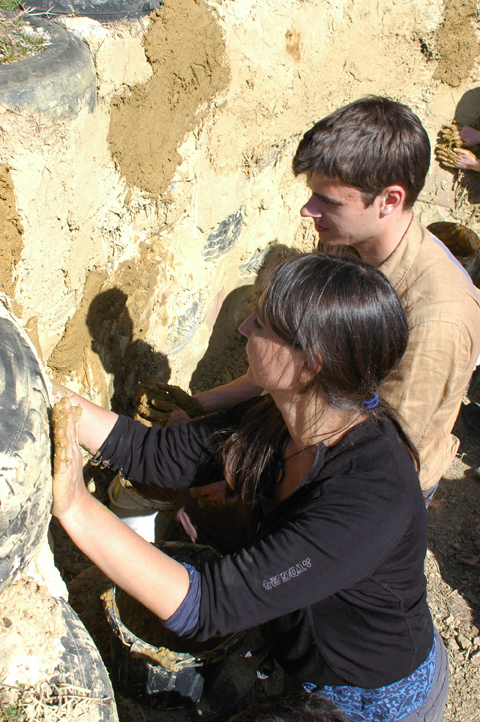
Several projects deliberately focus on the importance of the body in building, but rather than discussing strength as a key attribute, they teach that all builders need to re-learn how to use their whole body in building. This is most obvious in natural building where builders such as Paulina Wojciechowska of Earth Hands and Houses teach how to use our bodies in making and using earth plasters. Others, such as Shay Salomon (US) and the Mud Girls (Canada) lead women-only builds as places women can feel comfortable in themselves to try things out, experiment, and not be judged [Salomon, S (2006) Little House on a Small Planet: Simple Homes, Cozy Retreats and Energy Efficient Possibilities. The Lyons Press, Guilford, Connecticut].
Challenging the assumptions others and women themselves make about women’s mental capabilities is quite difficult. We need to identify and support leading female eco-builders such as Barbara Jones (Strawworks), Brenda Vale (The Autonomous House), Rachel Shiamh (Quiet Earth), Lydia Doleman (The Flying Hammer), Alix Henry (Henry Architects), Kirsten Jacobson (Earthship Biotecture), and Amanda Bramble (Ampersand Sustainable Learning Center), to name just a few. These women have already proved that gender is no barrier to being outstanding architects, builders, and designers. At the same time we need to celebrate diversity in building practice. By questioning the emphasis on strength we can instead stress the importance of other elements, like communication and listening, as being central to successful building. This is not to reject that certain engineering principles are best to follow, but we should acknowledge that there are multiple ways to build a good house.
Finally, in trying to change the broader societal expectations of what men and women do, we need to embrace gender as a form of diversity, but not as a division of labour. We need to create space for women to build and to acknowledge the work that many women already do on build sites. This is about making women’s contributions visible and valuing them in the language we use to describe houses. It is also about encouraging women to be whatever they wish, to learn from the knowledge we already have, but also to be free to make mistakes and have the space to learn from doing.
Next Steps
There are several steps we could take to get more women building eco-houses:
● Facilitate builders of all genders to reflect and discuss their assumptions and views. This should not be about blaming men for women’s limited involvement. Rather, change requires all participants to acknowledge there is a problem and collectively identify solutions.
● Educate on how many existing assumptions are sexist and unnecessary, and illustrate how many women are expert eco-builders through sharing examples of their technical work.
● Facilitate and run women-only building workshops through which to share skills, knowledge, and examples.
● Support women-only experimental space for building; a space which would enable women to experiment without being judged and to have the freedom to learn through doing.
● Establish women eco-build support groups as forums for sharing advice, stories, and experiences.
Keep the conversation going with these pieces
There are no available blogs
Subscribe to our newsletter for fresh stories and community updates delivered to your inbox.
Get unlimited access to courses, exclusive member events, and a supportive network of community builders
Access all courses, books, and premium content
Member-only workshops and community builders
Member-only workshops and gatherings
{{ item.label }}
{{ item.value ? item.value : currencyFormat( item.amount ) }}
Subtotal
{{ currencyFormat( pricing_summary.total_amount ) }}
There are no results matching your search