


When it comes to energy use, “show me the bills.” My electricity bill last year was minus $88, for the entire year. My highest monthly heating bill last winter was about $20, in the Lake Tahoe area.
A few years ago we designed a Unitarian Universalist Church in Fresno, California. Katie McCamant was the project architect. It was the first LEED (Leadership in Energy and Environmental Design) gold in all of central California. LEED today is the best we can do to institutionally and universally quantify “sustainability.”
In the next year, we designed a 28-unit cohousing community right next door. Many of the folks in the Unitarian Universalist congregation were involved in planning and ultimately moved into the cohousing community. I was the architect for the cohousing community and when planning it I asked the group, “Do you want to do the cohousing as LEED certified?” They chimed in all at once: “No way! Chuck, if we have an extra $40,000 to $50,000 sitting around, we’ll have them all converted to one-dollar-bills, grind them up and pour them into the walls as insulation; at least that way, we’ll get something for it.” It took somewhere between $40,000-$50,000 to get the 8″ x 10″ certificate for the church—and that was just the paperwork and buying the certificate. There was very little value added, and there was no way that the same client group wanted that rigmarole again.
I understand why the population wants a formula. To be honest, American architects have advertised conscientious, sustainable design for a long time, but have produced little more than rhetoric. In fact, a formula is necessary if not critical for 90 percent of the architects. They didn’t start doing or trying to make efficient buildings until someone came along and started measuring things. The problem is that for people who see neighborhoods more holistically, they are measuring the wrong things. They are not measuring how low your energy bills were. Instead they are measuring how many bells and whistles you had. The bells and whistles always cost more and break down more often, aren’t simple elegant solutions, but depend on gizmos and money. The Energy Star refrigerator is not always the one that is the most energy efficient—you end up using the more energy wasteful appliance because it gets you a LEED point.
Similarly, the passive house is another good formula if you have excess money and want to spend it on currently popular ideas. Again it often appears that if we can just come up with the latest magic bullet (straw bale, a passive house, or similar) we will beat the game. The best game is to be a clever practitioner, perhaps making buildings that improve the most conventional building practices—just as the most efficient autos are “engineered” like the Prius and know the many details that really matter. Look to evolve and engineer aggressively rather than to find the magic bullet. Look to further the craft of good practices, even when they’re conventional. We know that if we tweak conventional construction by 10 percent we can improve energy efficiency by 80-90 percent. Plan to employ carpenters and other artisans who can later modify buildings to new clients and uses.
Look at performance more than labels. People often say to us, “Oh yeah, that’s like the passive house,” or, “Yeah that will get you a couple of LEED points.” That’s not our concern. Our concern is: Do people love living there? Is it a high-functioning community?—because that is the crux of sustainability. Above all else, if it doesn’t work socially, why bother? Yes, we’re looking to have the lowest possible energy bills, the best natural ventilation, natural light, low toxic material, sustainably grown lumber (if we used lumber), flooring that is completely biodegradable, and much much more. But all in the context of working socially, being beautiful and elegant (because people take care of what they love and love what is beautiful), and in the context of what is affordable—predictably affordable. We are wedded to serving everyone in the group.
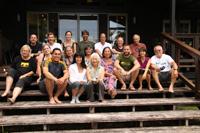
When it comes to sustainability, show me the community. So much sustainability is embedded in community. Last night I had dinner in the not-quite-new cohousing community in Grass Valley, California. A resident said that previous to moving into cohousing he was buying five to six tanks of gas per month; now he buys less than one. That’s because his all-important social life now happens in the neighborhood. Our 34-unit cohousing community in Nevada City, California shares one lawnmower, one table saw, one hot tub, one, one, one, lots of things. People there would think you were crazy if you proposed a second lawn mower. If I tried to co-purchase a lawn mower on the single-family house street where I once lived, they would think I was crazy.
When people come to the table with intention of cooperation, anything is possible, including saving our species, and that’s sustainable.
Keep the conversation going with these pieces
There are no available blogs
Subscribe to our newsletter for fresh stories and community updates delivered to your inbox.
Get unlimited access to courses, exclusive member events, and a supportive network of community builders
Access all courses, books, and premium content
Member-only workshops and community builders
Member-only workshops and gatherings
{{ item.label }}
{{ item.value ? item.value : currencyFormat( item.amount ) }}
Subtotal
{{ currencyFormat( pricing_summary.total_amount ) }}
There are no results matching your search