

Author: Helen Kolff
Published in Communities Magazine Issue #156
We started the Port Townsend EcoVillage because we had a vision: “A community of people living in harmony with each other and with the earth, exploring together ways to live more sustainably.” That was eight years ago and we are still here and thriving!
We spent nearly every Sunday afternoon for years meeting to make that vision a reality. We engaged in lively debates about what legal structure would be ideal and actually went from an LLC, to a Co-op, to a Home Owners’ Association (see “To Be or Not To Be an LLC,” Communities, Winter 2006, #133). After seven years, the landowners and cofounders decided to end the debate and temporarily suspended consensus (see “Money, Power and Process: How We Pulled The Plug On Consensus,” Communities, Fall 2010, #148).
We are happy to report that we are living our vision even though we have had to make a number of compromises due to the constraints (lemons) of reality.
First, we chose to locate our ecovillage within the urban growth area of Port Townsend (in Jefferson County, Washington). This turns out to have its blessings and its downsides. We live within biking and walking distance of lively cultural venues, a vibrant food co-op, and an exquisite state park right on Puget Sound, so car use can be minimal. Our members are engaged in many meaningful activities outside our ecovillage in this happening town. However, this meant that land prices are higher and city building codes are more stringent than in rural areas. By choosing to be in the public eye, we are limited in some of the innovations we might be able to explore in a less restrictive regulatory environment.
Second, we live in the US where the dominant culture is based on individual ownership of property, as well as onerous financial and legal costs in a system with a shaky social safety net. We found it nearly impossible to get loans from local banks, even from lending institutions that had a history of making loans to cooperatives. This may have been due to both the economic recession and the fact that we tried to form first an LLC and then a limited equity co-op—legal ownership models outside the mainstream. When we tried to find insurance coverage, we had difficulty even after we became a Home Owners’ Association. Surprisingly, an insurance agency that covered a neighboring HOA chose not cover us. We did succeed in finding insurance coverage, a prerequisite of being granted our planned unit development by the City of Port Townsend.
So, how are we mitigating these constraints and obstacles? How are we making lemonade out of lemons?
Lemon A: Expensive land and private ownership culture
We came up with some creative financial solutions:
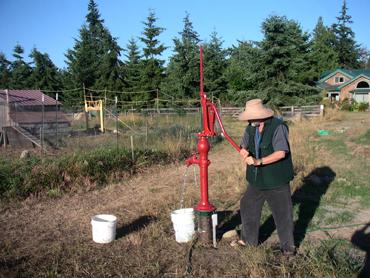
• Lemonade #1: Although we are organized as a Home Owners’ Association with privately owned lots, we share ownership of all the rest of the common property. This includes the last five (of 12) lots that have not been sold yet, nearly seven acres of land with a small forest and excellent agricultural land. In addition, we jointly own a large duplex called the CoHo that we rent out and are using as a temporary common house, a 3600 square-foot art center, and a well for watering our gardens.
• Lemonade #2: We promote some degree of affordability by encouraging those who currently don’t have the means to buy a lot and build a home to be a part of the Port Townsend EcoVillage by renting a room or living unit in the CoHo. This has made it possible for us to enjoy the exciting energy of young families and others with lots of talents and gifts. The rent from the CoHo keeps member assessments to a minimum.
• Lemonade #3: We encourage people to enter into joint tenancy agreements to buy in and build a home together. Currently, there are three lots that are owned in this way. Our assessments are based on a formula that takes into account and encourages the shared ownership of a single lot.
• Lemonade #4: We have agreed to share a percentage of the profits from the sale of any of the lots and homes. Equity is thereby somewhat limited so that profits can be put into our discount fund, allowing us to offer financial discounts to potential members who would not otherwise be able to buy in.
• Lemonade #5: The original landowners offer a low interest load on part of the cost of buying a lot. Some members have offered low interest loans to other members who needed them to complete the construction of their homes. When the homes are completed, owners have the opportunity to obtain a mortgage and repay the loans from fellow members.
Lemon B: Restrictive City codes
How have we addressed the restraints of our local City codes? We are trying to be as sustainable as we can be given these code and zoning requirements. In applying for our Planned Unit Development permit, the City allowed no composting toilets without being hooked up to the sewer system, no satellite bedrooms (structures that serve as a bedroom with a shared bathroom and kitchen in a commonly owned building that is not attached), no wind turbines due to height restrictions, no simple gray water systems (unless the system was engineered and met extensive regulations), no unpaved sections of existing paved roads, no grassy path (instead of a paved sidewalk), and no additional houses on the north part of the property without paving the whole length of the street (at a cost of about $150,000).
In order to be as sustainable as possible in spite of our City codes, we have voluntarily agreed to a number of restrictions that are part of our internal legal documents. Here is a list of some steps we are taking toward sustainability as an ecovillage:
Various Flavors of Lemonade:
• We limit our house size to 1200 square feet of heated space and no more than 1200 square feet of covered surface per lot.
• We own an electric car and share other vehicles.
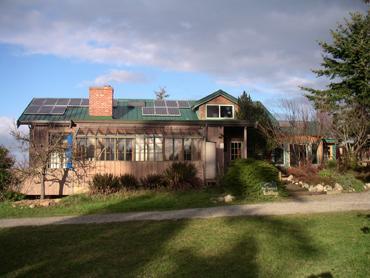
• We installed solar panels on our rental house.
• We make solar access a priority when planning house sites.
• We share tools, washing machines, and other equipment.
• We use organic seeds and compost whenever possible.
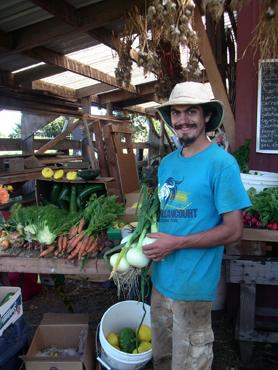
• We have reserved three acres of our land for growing food and have a CSA.
• We lease garden space that is currently not needed by members.
• We avoid the use of toxic chemicals in building and maintaining our homes.
• We promote water catchment systems and share a well for watering gardens.
• We have a shared composting toilet, art center, and rental house.
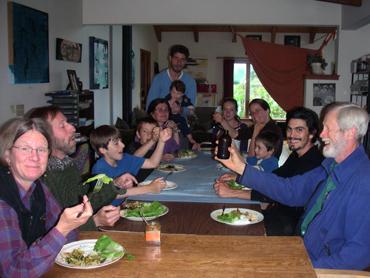
And our juiciest lemonade is our process. Just as important as ecological sustainability, we pay particular attention to human sustainability here at the Port Townsend EcoVillage. Our Process Team regularly takes a pulse of the health of our community’s “organism.” We evaluate whether there are unresolved conflicts, a need for community-building, a topic that should be addressed, or a celebration that is called for. We are blessed to have a wide variety of group facilitation skills and expertise among our members. We use improvisational theater exercises such as fluid sculpture, Zegg Forum format for personal sharing, Nonviolent Communication and mediation, the Mandala Process we learned from Robina McCurdy, C.T. Butler’s method of building consensus, the Enneagram to learn more about personality differences, Diversity and Social Justice work, Joanna Macy’s “Work that Reconnects” approach, group participation singing, and self-designed seasonal celebrations and retreats.
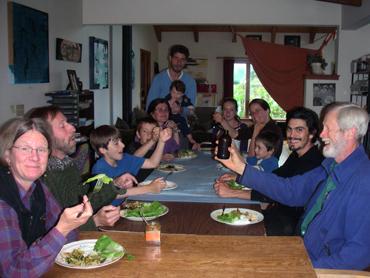
One example of our process is our Solstice Celebration. In a festive way, we drum and sing our way out to our forest fire circle that has been decorated with rose hips, holly, cedar boughs, and ribbons. Encircling the ceremonial fire, we take a sprig of lavender and a pinch of herbs to represent qualities we want to leave behind and invite into our lives in the coming year. We step forward, share those qualities, and toss them into the fire. Sometimes the coyotes sing along with us as we leave to go back to our cozy common house. With anticipation, we each take part in the “Give Away,” a time when we lay out a prized possession that has meaning and power for us but one that we are willing to part with. We take turns choosing one of these objects as our gift and hearing the story behind it as told by the giver. We then enjoy a scrumptious feast complete with toasts of appreciation to one another. There is nothing like sharing appreciations to build a strong sense of community among us. We all really enjoy the camaraderie, good cheer, and meaning of the solstice time of year.
This emphasis on both product and process is allowing us to make some very zesty lemonade out of the lemons and other constraints we have encountered on the way to realizing our vision at the Port Townsend EcoVillage.
Keep the conversation going with these pieces
There are no available blogs
Subscribe to our newsletter for fresh stories and community updates delivered to your inbox.
Get unlimited access to courses, exclusive member events, and a supportive network of community builders
Access all courses, books, and premium content
Member-only workshops and community builders
Member-only workshops and gatherings
{{ item.label }}
{{ item.value ? item.value : currencyFormat( item.amount ) }}
Subtotal
{{ currencyFormat( pricing_summary.total_amount ) }}
There are no results matching your search