
Author: Elke Cole
Published in Communities Magazine Issue #147
My name is Elke Cole and I am a communitarian…no, wait, strike that, that’s a little vague…I’m a natural builder…ummm maybe not quite it, I’m not just a builder…I, I, well I live in community.
That’s not a bad start to describe the way I live. I live and learn. Or is it that I learn and then I live? Maybe it’s both. And I dance learning and living every day here at One United Resource (O.U.R., or OUR for short) Ecovillage on Vancouver Island, British Columbia.
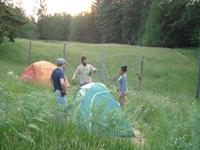
Here on the island we can live outdoors from late April to mid October. This means that a large part of the on-site programs I’m involved in are conducted during this time, as off-site learners can come and camp in fine favourable weather.
Those of us who live here year-round occupy conventional and natural buildings, yurts and trailer spaces in winter, and some join the camp as soon as weather allows. I am fortunate to have my living and work space in what we affectionately call the Art Studio, destined to be an “artist in residence” accommodation complete with gallery space and studio. Here I am able to plan programs, complete all necessary computer work, and work on my personal design projects. Come sunshine and summer, I’m outside wearing the teacher and program leader hat. My living space then becomes the private refuge from being “on.” Taking a break from the public hats of teacher and leader, I can step from the public realm into my own personal space, where I recharge, reload, and relax from work. Besides removing myself from others, I’ve found another way to let people know that I’m on time off: I put on a skirt!
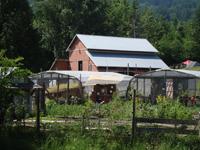
There is a great appetite in the world for examples of sustainable land use, and in our “show me it in action” world, seeing really is believing. We share examples of natural homes, permaculture in action, composting toilets, greenhouses full of greens in April, ponds for irrigation, chickens, ducks, sheep, pigs and most importantly how all of us people live and work together!
I understand that tours and public inquiry form part of my agreement here: raising awareness and promoting our workshops support my work as designer and teacher. There is a business side in all of this: we intend to make a living right here. Some of us have small individual businesses here, and the nonprofit organization operates accommodation and food services as well as the school.
Living in the middle of a demonstration site means living under observation. So when the public tours come through, I make my living space look good for the pictures and then… go for coffee.
There are about a dozen of us sharing the ebb and flood of seasonal activity. Living here means holding space for those who come to lend a hand to the site.
There’s always more work than hands, and the core group of people struggles to find time for deeper connection. We have families and partners, meetings and work, and everybody needs some quiet time. As much as we respect personal space and time, it’s often not easy to claim. What keeps us here is a sense that what we do is important on a larger scale. There’s a greater calling that brings us into community to live and to educate ourselves and others.
For OUR school (TOPIA: The Sustainable Learning Institute) every season is another adventure: I personally don’t want to get stale by teaching “on automatic,” so I continually look for ways to do things differently. At the same time I understand that invisible structures carry us through our work. These structures consist of agreements that govern how we work and live together. We organize ourselves in teams: the kitchen team works closely with the garden team to feed us all. I start with this team because good food is at the heart of every successful workshop!
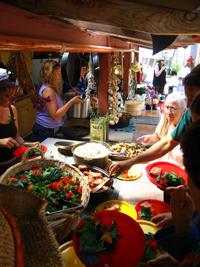
OUR kitchen also processes a lot of the produce for winter consumption by drying and canning. The ongoing challenge is to provide good food on a tight budget, and try to work with all the different politics that come up when we discuss sustainable food issues. One response to that is “OUR Food Manifesto,” written in 2008. This document helps to educate visitors, interns, and potential residents of OUR approach to food and its transformation through our kitchen. As our garden becomes bigger every season, so does the percentage of food harvested on site.
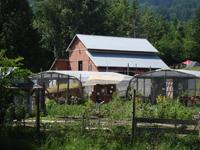
The garden team cares for the growing area that’s protected by an eight-foot deer fence (with perimeter expanding!) and includes two large greenhouses. In 2009 the gardens were filled with song. The Sustainable Food Production team strongly believed what our ancestors knew instinctively—song is part of a strong work ethic. Their voices carried throughout the land, giving the other teams an opportunity to pause and question, “What does work entail?”
Questions our garden looks to answer are: how do we feed the number of people on site in a climate that has most output late in summer while programs are heaviest in early to mid summer? How do we continue to keep and build soil while obtaining and improving yields? How do we find a way of managing our energy and how can we integrate new people?
On a developing site there’s lots of work for builders. The building team is made up of residents, a few hired workers, instructors, interns, and students practicing a combination of conventional skills and natural building. The natural building program works on real building sites, of which there are always a few underway: you may learn foundation work on one, cob on another, and finish plaster on yet a third structure. This means that interns can see and work on buildings in all states of completion.
We call it “slow building”: buildings take longer to complete when main components are part of our teaching and our season for programming is limited to favourable camp season, typically May to September.
None of our activities would function without the support of the office team. Like it or not, administration is a lot of work and requires fantastically capable and hard-working people. Here I’ve seen programs flourish or flounder with the work of the administrative staff. This is the place of first contact: the voice you hear when you call, the place where everyone is received, and where connection is made. This is where funding proposals are written, registration is handled, bookings made. It’s where books are kept and websites are maintained. This is truly where the magic happens.
Lastly I want to acknowledge that most of us are having to wear many hats. On the same day I am asked to, accept, and choose to be a designer, builder, coordinator, mentor, blogger, communicator, team member, hearthkeeper, partner, and friend.
Whew…that’s a lot of hats. Good thing I have a strong neck. Not to mention a strong sense of self.
And here’s my motivation: How do I create a good life in this time of change?
My answer is building personal connections, doing things together, learning from each other, and sharing the work. That’s what has me wake up in my cob sleeping alcove facing the sun and ready to face another day as a communitarian, I mean natural builder…ah heck with it…to face the day with my friends and family.
And that’s good enough for me.
Keep the conversation going with these pieces
There are no available blogs
Subscribe to our newsletter for fresh stories and community updates delivered to your inbox.
Get unlimited access to courses, exclusive member events, and a supportive network of community builders
Access all courses, books, and premium content
Member-only workshops and community builders
Member-only workshops and gatherings
{{ item.label }}
{{ item.value ? item.value : currencyFormat( item.amount ) }}
Subtotal
{{ currencyFormat( pricing_summary.total_amount ) }}
There are no results matching your search